Four Prong Versus Six Prong for Diamond Rings
A diamond’s setting does more than hold it in place. It shapes how large the stone looks, how much light reaches it, how easily it fits into daily life, and even how it feels on your hand. When comparing four prong versus six prong settings, the right answer is rarely universal. It depends on your diamond shape, your lifestyle, and whether your eye is drawn to a clean, open look or a classic, protective frame.
For an engagement ring or custom diamond ring, prongs are a small design detail with a major visual and practical role. Understanding the trade-offs makes it easier to choose a setting you will still love years from now.
Four Prong Versus Six Prong: The Core Difference
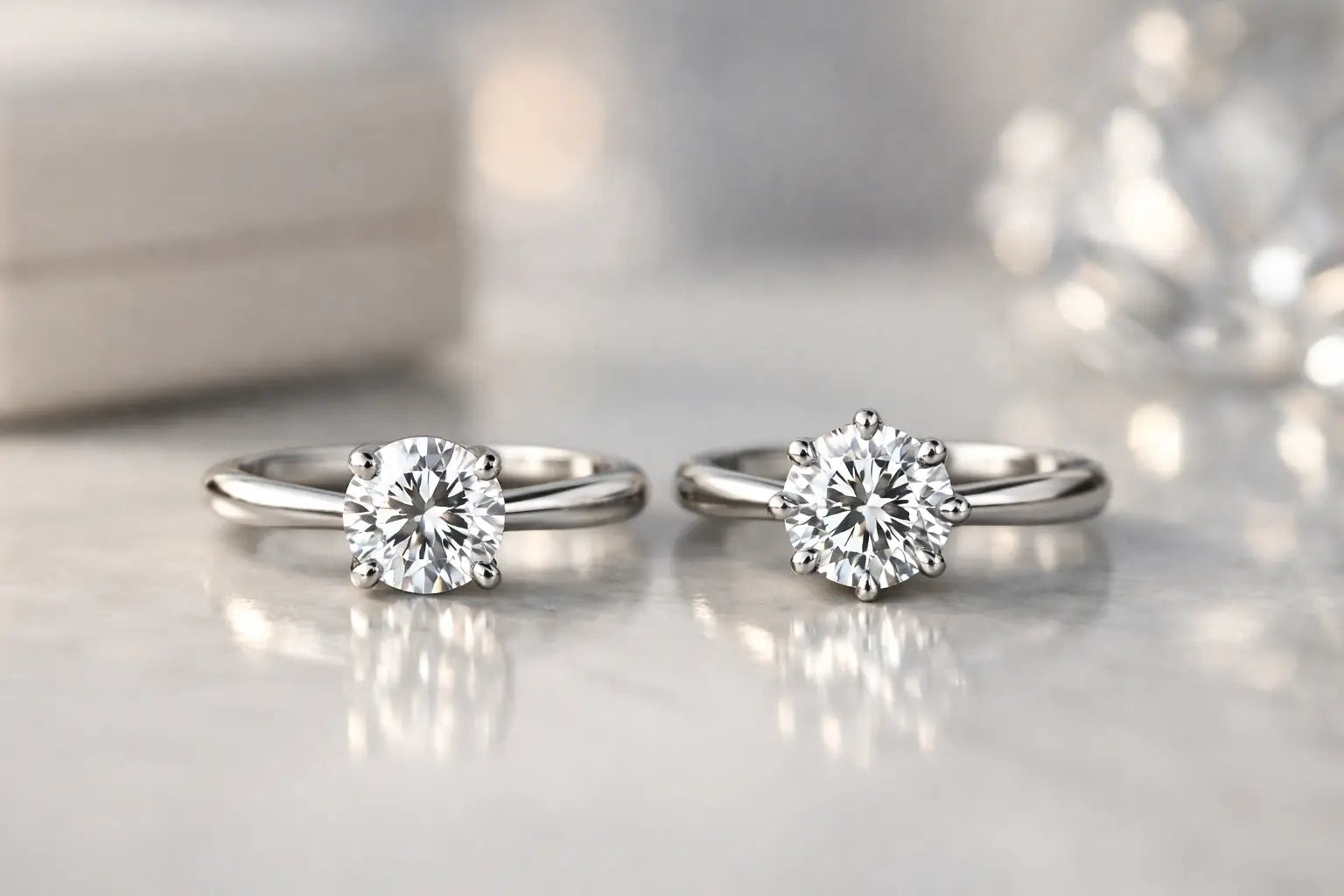
A prong setting uses small metal claws to secure a diamond at its edge. A four-prong setting places four points of contact around the stone, while a six-prong setting adds two more. Both can be beautifully made, secure, and suitable for a lab-grown diamond or a natural diamond.
The central difference is coverage. Four prongs leave more of the diamond visible, creating an airy appearance and allowing the stone’s outline to take center stage. Six prongs surround more of the girdle, the outer edge of the diamond, for added support and a more traditional silhouette.
More prongs do not automatically mean one setting is better made than the other. Prong quality, metal choice, diamond size, stone shape, and regular maintenance all matter. A well-crafted four-prong setting can provide dependable everyday wear, just as a poorly maintained six-prong setting can eventually need attention.
Why Choose a Four-Prong Setting?
Four-prong settings are loved for their minimal, bright look. With less metal covering the diamond, more of the stone remains visible from the top. This can make a center diamond appear slightly larger and more defined, especially when paired with a narrow band or a simple solitaire design.
A more open view of the diamond
If your priority is seeing as much of your diamond as possible, four prongs are often the natural choice. They can show off the distinctive outline of a radiant, cushion, oval, emerald, or pear-shaped diamond with less interruption from metal.
Four prongs can also create a more contemporary feel. On round diamonds, they often form a subtle square-like visual frame, which appeals to buyers who prefer a cleaner, less traditional engagement ring profile.
A smart match for certain diamond shapes
Four prongs are especially common for princess-cut diamonds, where each pointed corner benefits from being protected by a prong. They are also popular on emerald-cut and radiant-cut diamonds because the setting keeps the crisp geometry of the stone visible.
For oval, pear, and marquise diamonds, four prongs can look elegant, but placement matters. A pear or marquise diamond should have a protective V-shaped prong over its vulnerable point. That pointed tip is more susceptible to chipping than a rounded edge, regardless of whether the setting has four or six prongs.
The trade-off: fewer points of contact
With four prongs, each individual prong does more of the work. If one becomes loose, bent, or worn over time, the diamond may have more room to shift than it would in a six-prong setting. This does not make four prongs unsafe. It simply means routine inspections are especially worthwhile.
A four-prong ring may be ideal for someone who wants a refined, low-metal look and is comfortable caring for fine jewelry thoughtfully. Removing the ring for weight training, gardening, housework, and hands-on projects also helps protect both the setting and the diamond.
Why Choose a Six-Prong Setting?
A six-prong setting is an enduring favorite for round brilliant diamonds. The extra prongs create a balanced, flower-like frame around the stone and provide additional contact points at the girdle. It is a classic choice for buyers who want an engagement ring with a substantial, timeless presence.
Added reassurance for daily wear
Six prongs distribute the job of holding the diamond across more points. If one prong is damaged or begins to loosen, the others can offer an added measure of temporary security while the ring is brought in for inspection or repair.
That extra support can be appealing for an active lifestyle, a larger center stone, or a diamond that sits high above the finger. It is also a practical consideration for someone who wants the visual confidence of a more protected setting without moving to a bezel, which surrounds the diamond with a continuous rim of metal.
A classic look for round diamonds
On a round diamond, six evenly spaced prongs complement the stone’s circular outline. The result is often softer and more traditional than a four-prong design. For many couples, this is the engagement-ring look they have pictured for years.
Six prongs can be styled as rounded claw prongs, delicate pointed prongs, or more substantial traditional prongs. The number alone does not determine whether the ring feels modern or vintage-inspired. The metalwork, band width, gallery details, and diamond proportions all influence the final personality of the ring.
The trade-off: more visible metal
The extra prongs cover slightly more of the diamond’s edge. On a very small center stone, they can look proportionally more noticeable. They may also collect lotion, soap, and everyday residue around the stone more readily, although all prong-set rings benefit from gentle, regular cleaning.
For buyers who want the diamond to look as open and expansive as possible, six prongs may feel a touch busier than four. That is a style preference, not a quality issue.
How Diamond Shape Changes the Decision
The four-prong versus six-prong conversation is most direct with round diamonds, but diamond shape should always guide the setting design.
Round diamonds work beautifully in either style. Choose four prongs for a more open, contemporary look, or six for a classic outline and added contact points. Oval diamonds are frequently set with four or six prongs. Four can emphasize the elongated shape, while six can provide a more evenly supported appearance, particularly for a larger oval.
Emerald-cut and radiant-cut diamonds are commonly held by four corner prongs because the clean corners are part of their appeal. A six-prong arrangement can work, but it should be designed carefully so the additional prongs do not interrupt the stone’s elegant lines.
Pear, marquise, and heart-shaped diamonds need special attention at their points. A V-prong is often more important than the total number of prongs because it shields the most delicate area from direct impact. Cushion diamonds are flexible and can look beautiful with four or six prongs, depending on whether you prefer a more open or more framed appearance.
Security Is About Craftsmanship and Care
Prong count is only one part of diamond security. A properly fitted setting should hold the diamond firmly without excessive pressure on the stone. The prongs should be smooth, evenly placed, and shaped to protect the girdle without overwhelming the diamond.
Metal choice matters too. Platinum is durable and naturally white, while gold offers distinct color options and can be an excellent choice when the setting is designed and maintained well. White gold may need occasional replating to preserve its bright white finish. Yellow gold and rose gold create warmth and contrast that can make a colorless lab-grown diamond stand out beautifully.
No prong setting is maintenance-free. Check your ring periodically for snagging, a stone that feels loose, or prongs that appear worn down. Fine jewelry should be professionally inspected on a regular schedule, particularly after an impact or if you wear it every day. A small adjustment made early can help prevent a larger repair later.
Choose the Setting That Fits Your Style
If you want maximum diamond visibility, a lighter visual profile, and a modern solitaire feel, four prongs may be your best match. If you prefer a timeless round-diamond look, more visible framing, and additional points of support, six prongs may feel more reassuring.
It also helps to consider the ring as a complete design. A delicate band with a high-set diamond may call for a different setting approach than a low-profile ring built for constant wear. A custom design consultation can refine the prong shape, setting height, metal, and diamond proportions together rather than treating any one detail in isolation.
The best choice is the one that lets you look at your ring every day and feel that it reflects you. Whether that means the open brilliance of four prongs or the enduring symmetry of six, thoughtful design turns a practical setting into part of the story your jewelry carries.