IGI vs GIA for Lab-Made Diamonds: Which Certification Matters in 2026?
In 2026, the prestigious GIA "gold standard" might actually provide less information than you expect for your lab-grown diamond purchase. While GIA remains a titan in natural stones, their recent shift to broad "Premium" or "Standard" assessments has left many custom jewelry buyers feeling uncertain. When you are comparing igi vs gia for lab diamonds, you aren't just choosing a brand; you're deciding how much technical data you want to see before making a significant investment. It is common to feel torn between the legacy of one lab and the detailed clarity reports of the other, especially when prices for seemingly identical stones do not seem to align.
We understand that choosing a center stone for a made-to-order piece is both a financial and emotional milestone. You deserve to know exactly why a specific diamond earns its grade without fearing you have overpaid for a name. This article provides a clear framework to help you navigate these competing reports with confidence. We will explore the technical differences in how these labs evaluate light performance and why IGI’s specific 4Cs grading remains the dominant choice for over 80% of the lab-grown market. By the end, you will have the assurance needed to select a stone that retains its brilliance and technical value for a lifetime.
Key Takeaways
- Identify the critical reporting differences in 2026, specifically how GIA’s new quality assessments compare to IGI’s detailed 4Cs grading for lab-grown stones.
- Navigate the pricing landscape with clarity by understanding why comparing igi vs gia for lab diamonds often reveals a 5-15% cost difference for stones of identical visual quality.
- Recognize why IGI has become the global industry standard for lab-grown diamonds, currently certifying over 80% of the world's supply with technical precision.
- Learn to prioritize the right certification based on your custom jewelry needs, balancing legacy prestige with the transparency required for bespoke craftsmanship.
- Discover how to use these independent reports as a foundation for an expert diamond consultation, ensuring your chosen stone meets the highest ethical and aesthetic standards.
Understanding Diamond Certification: The Roles of IGI and GIA
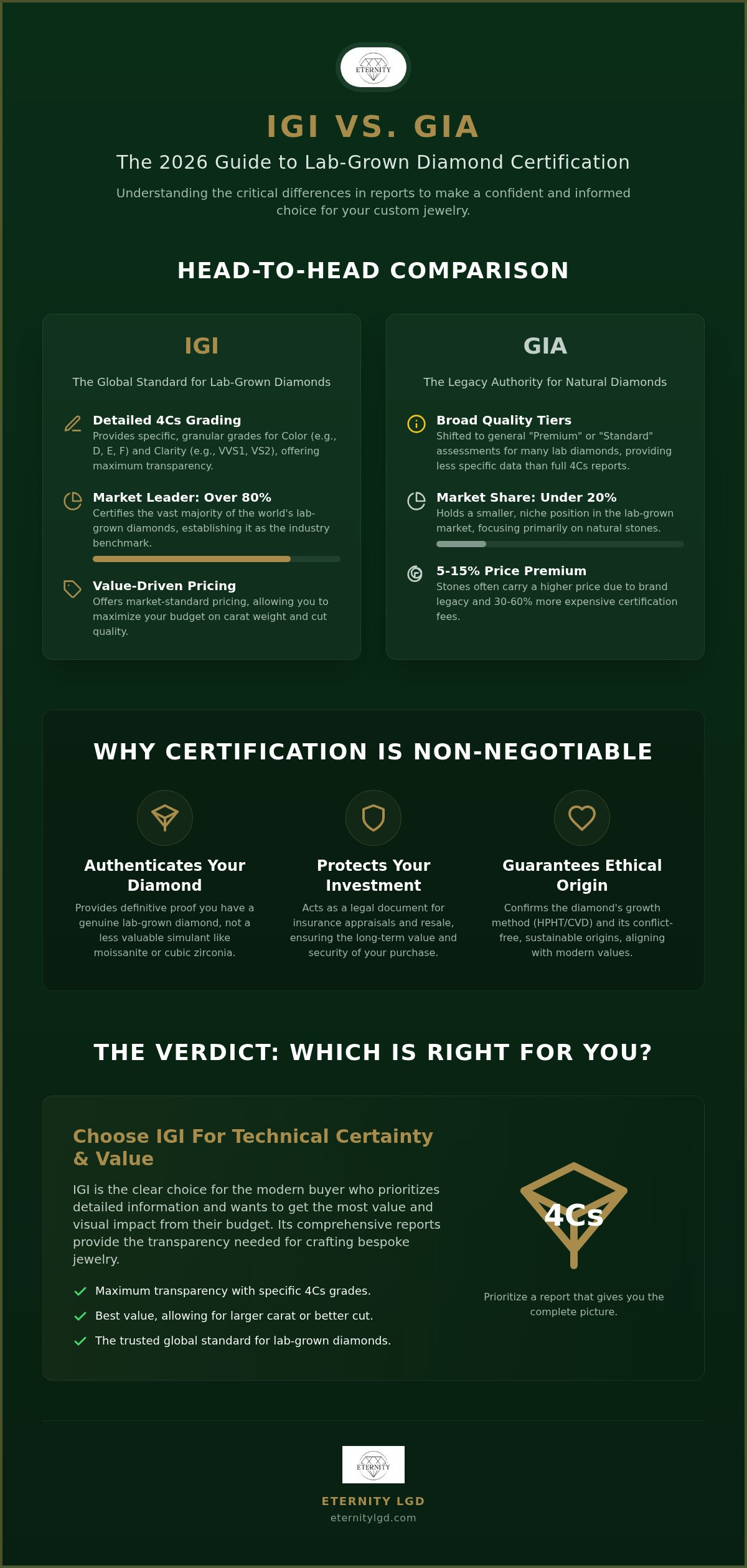
A diamond certificate acts as a definitive blueprint of a stone’s DNA. This document, verified by an independent third-party laboratory, provides the objective data necessary to understand a diamond's unique characteristics. Lab-made diamonds are chemically, physically, and optically identical to mined stones, requiring the same rigorous grading standards to determine their true quality. While the Gemological Institute of America (GIA) established the 4Cs and remains the legacy authority for mined diamonds and high-carat investments, the International Gemological Institute (IGI) has emerged as the primary grader for the lab-grown market. This evolution is vital when evaluating igi vs gia for lab diamonds. IGI was the first major lab to provide full, detailed reports for stones grown in a laboratory setting, providing the transparency that early adopters demanded. Today, IGI certifies over 80% of lab-grown diamonds globally, offering a level of specialization that has transformed the modern jewelry industry.
Why Certification is Non-Negotiable in 2026
Authentication is your first line of defense against simulants. Without a verified report, it's nearly impossible for an untrained eye to distinguish a genuine lab-grown diamond from simulants like moissanite or cubic zirconia. Beyond simple identification, these documents are essential for insurance appraisals and protecting your investment. A certificate ensures that the stone you've selected for your custom jewelry is exactly what the report suggests, providing the necessary assurance for your bespoke journey.
The 2026 Industry Shift Toward Transparency
Modern laboratories now utilize advanced spectroscopy to confirm the specific growth method, whether it's Chemical Vapor Deposition (CVD) or High Pressure High Temperature (HPHT). This technical precision allows for complete origin verification, which is a cornerstone of ethical and sustainable sourcing. The industry has shifted toward total transparency. Reports don't just list the 4Cs anymore; they confirm the conflict-free nature and sustainable footprint of the stone. This data empowers you to make an informed, value-based decision that aligns with your personal ethics and aesthetic standards.
Comparing Grading Standards: Strictness, Value, and the 4Cs
The technical evaluation of a diamond is a blend of scientific measurement and expert observation. While grading is inherently subjective, both laboratories utilize the same International Diamond Grading System to evaluate the physical properties of lab-made diamonds. When weighing igi vs gia for lab diamonds, the primary difference often lies in the depth of information provided in 2026. IGI continues to offer specific color and clarity grades for every stone, while GIA laboratory-grown diamond services have transitioned toward a broader "Premium" or "Standard" assessment for many stones. This shift has made IGI the preferred choice for buyers who demand granular technical data to justify their purchase.
There's a long-standing perception that GIA is "stricter" than IGI. Historically, a GIA grade might be one step more conservative in color or clarity. However, this gap has significantly narrowed as IGI has tightened its internal standards to meet the demands of the modern luxury market. Choosing a GIA-certified stone often carries a 5-15% price premium. This isn't necessarily because the diamond is visually superior. Instead, it reflects a brand premium and the higher fees GIA charges for its reports, which can be 30-60% more expensive than IGI's certification process.
Cut Quality: The Most Important Factor for Sparkle
Cut quality dictates how light travels through the stone. It's the engine of a diamond's brilliance. An "Ideal" grade from IGI or an "Excellent" grade from GIA is essential for maximizing sparkle. While both labs evaluate symmetry and polish, they use slightly different algorithms to calculate light return. IGI's "Hearts and Arrows" designation is particularly helpful for identifying stones with near-perfect optical symmetry, ensuring your diamond doesn't just look good on paper, but truly dances in the light.
Maximizing Your Budget with IGI Reports
If you want the most visual impact for your investment, IGI reports offer an efficient path. You can often find "eye-clean" stones at a lower price point than GIA alternatives, allowing you to allocate more of your budget toward a larger carat weight or a more intricate setting. This value-driven approach is why many collectors choose IGI when comparing igi vs gia for lab diamonds for their custom lab grown diamond bracelets. Selecting several smaller, high-performance stones is much more accessible when you aren't paying a brand premium on every single certificate. To see how these technical grades translate into a finished piece, we recommend scheduling a personalized consultation to view stones in person.
From Certification to Craftsmanship: Making an Informed Choice
A diamond certificate provides the technical foundation, but it is the artistry of the setting that brings a stone to life. While the debate over igi vs gia for lab diamonds often focuses on paper specifications, the final impact of your jewelry depends on how those specs translate into a physical piece. For a center stone in an engagement ring, you might prioritize the granular clarity details found in an IGI report. Conversely, for a minimalist necklace where the GIA name adds a layer of traditional prestige, a "Premium" assessment may suffice. The key is to use the report as a guide rather than a final verdict. At Eternity, the Eternity difference: custom sustainable jewelry centers on this philosophy. We curate both IGI and GIA certified stones, selecting the specific diamond that best aligns with your design goals and ethical standards.
Expert consultations serve as the bridge between technical data and visual beauty. A master jeweler can explain why a stone with a specific depth percentage will perform better in a bezel setting versus a prong setting. They help you look past the grades to see the actual light return and character of the diamond. Remember, the certificate is the beginning of the journey, not the destination. The craftsmanship of the metalwork and the precision of the stone’s placement are what ultimately define the piece's longevity and brilliance.
The Made-to-Order Journey
Bespoke design is particularly vital for high-carat lab-made diamonds. A custom setting ensures that the proportions of the jewelry perfectly complement the unique dimensions of your certified stone. This is especially true when you choose and design the perfect lab diamond bracelet. In a multi-stone piece like a bracelet, matching the color and sparkle across several certified diamonds creates a seamless, high-end look that off-the-shelf options simply cannot replicate. Custom settings also provide superior security, protecting your investment for decades to come.
Long-Term Ownership and Maintenance
Owning a lab-made diamond is a lifetime commitment that requires mindful care. Although these stones possess the same legendary durability as mined diamonds, they still accumulate oils and dust that can dull their fire. Regular professional check-ups ensure that prongs remain tight and the stone stays secure. For daily maintenance, we recommend following an expert guide on how to clean lab grown diamond jewelry. Keeping your certified stone pristine ensures that the technical quality you carefully selected in the grading report continues to shine as brightly as the day you first wore it.
Designing Your Future with Technical Clarity
Selecting between igi vs gia for lab diamonds is a decision that balances legacy brand recognition with modern technical transparency. We have explored how IGI provides the detailed 4Cs data essential for value-conscious buyers, while GIA serves those seeking traditional prestige. Ultimately, the certificate ensures authenticity, but your personal consultation is what transforms these specifications into a piece of wearable art. This collaborative process ensures that the technical grades on a report align perfectly with the visual brilliance you expect from a premium stone.
At Eternity, we curate both IGI and GIA certified loose diamonds to serve as the heart of our made-to-order bracelets and rings. Our focus on carbon-neutral sourcing and bespoke luxury ensures your choice is as ethical as it is beautiful. Begin your custom diamond consultation today to discover how we pull back the curtain on the industry. We look forward to guiding you through this creative journey to find a stone that perfectly captures your unique vision and celebrates your most significant milestones.
Frequently Asked Questions
Is IGI as good as GIA for lab-grown diamonds?
Yes, IGI is considered the established industry standard for lab-grown diamond certification due to its early adoption and detailed grading reports. While GIA remains the traditional authority for natural stones, their 2026 reporting for lab-grown diamonds has shifted toward broader quality assessments. This makes IGI a preferred choice for buyers who want specific color and clarity grades to ensure they are getting exactly what they pay for in a custom piece.
Why are most lab-grown diamonds certified by IGI instead of GIA?
IGI dominates the market because it was the first major laboratory to provide full, transparent grading reports specifically for the lab-grown sector. Currently, IGI certifies over 80% of the world's lab-grown diamonds. Manufacturers often choose IGI because their certification fees are 30-60% lower than GIA's. These savings are passed down to the consumer, making the choice of igi vs gia for lab diamonds a significant factor in overall value.
Can a jeweler tell the difference between an IGI and GIA certified diamond?
A jeweler cannot distinguish between these diamonds simply by looking at the stone; they must examine the microscopic laser inscription on the diamond's girdle. Both laboratories use identical scientific equipment to measure light performance and chemical composition. The difference lies entirely in the reporting style and the laboratory name on the certificate. This is why we encourage clients to focus on the visual brilliance of the stone during our personalized consultations.
Do lab-made diamonds with GIA certificates have a higher resale value?
GIA-certified lab-grown diamonds often carry a 5-15% price premium at the time of purchase, but this rarely translates to a significantly higher resale value. Resale prices for lab-made stones are primarily determined by the current market value of the physical diamond rather than the name of the laboratory. When evaluating igi vs gia for lab diamonds, it's more important to prioritize a high-quality cut and clarity that will ensure the stone retains its beauty for a lifetime.
Disclaimer
The information provided in this article is for educational and informational purposes only and should not be considered professional financial, legal, investment, or gemological advice. While Eternity strives to ensure all information is accurate and up to date, diamond grading standards, market prices, industry practices, and product availability may change over time.
All opinions expressed are based on current industry knowledge and are intended to help consumers make informed decisions. Product specifications, pricing, promotions, and services may vary and are subject to change without notice.
Lab-grown diamonds sold by Eternity are independently graded by recognized laboratories such as IGI or GIA where applicable. We encourage customers to consult with our jewelry specialists for recommendations tailored to their individual needs before making a purchase.
© Eternity Inc. All rights reserved. This content may not be reproduced without written permission.