Lab Grown Diamond Engagement Rings: The 2026 Guide to Modern Luxury
Choosing a lab-grown diamond is no longer a compromise on quality; it's a deliberate choice for the modern connoisseur who values both brilliance and a clear conscience. You might worry that opting for lab grown diamond engagement rings means sacrificing the prestige of a "real" stone or settling for something that feels less authentic. It's completely natural to feel overwhelmed by technical jargon and the pressure to get such a significant purchase exactly right.
This guide replaces that uncertainty with the clarity of an expert advisor. You'll learn how to balance ethical sourcing with technical specifications to find a diamond that's physically and chemically identical to one from a mine. We also clarify the differences between IGI and GIA certifications so you understand the true value of your investment.
We explore the 2026 standards for modern luxury, moving from the selection of high-quality loose stones to the rewarding journey of bespoke design. By the end, you'll have a clear path to a ring that reflects your personal style and your values without any guesswork.
Key Takeaways
- Confirm that lab-grown diamonds are 100% real diamonds, sharing the exact carbon structure and physical properties of mined stones.
- Learn why choosing lab grown diamond engagement rings allows you to prioritize a superior cut grade, ensuring maximum brilliance without the traditional luxury markup.
- Demystify the certification process by understanding how IGI and GIA reports protect your investment and guarantee technical quality.
- Explore the transparent made-to-order process, where you can select a loose diamond and collaborate on a setting that is uniquely yours.
- Identify the differences between ready-stock convenience and the intentional, step-by-step journey of a bespoke creation.
Understanding the Brilliance and Ethics of Lab Grown Diamond Engagement Rings
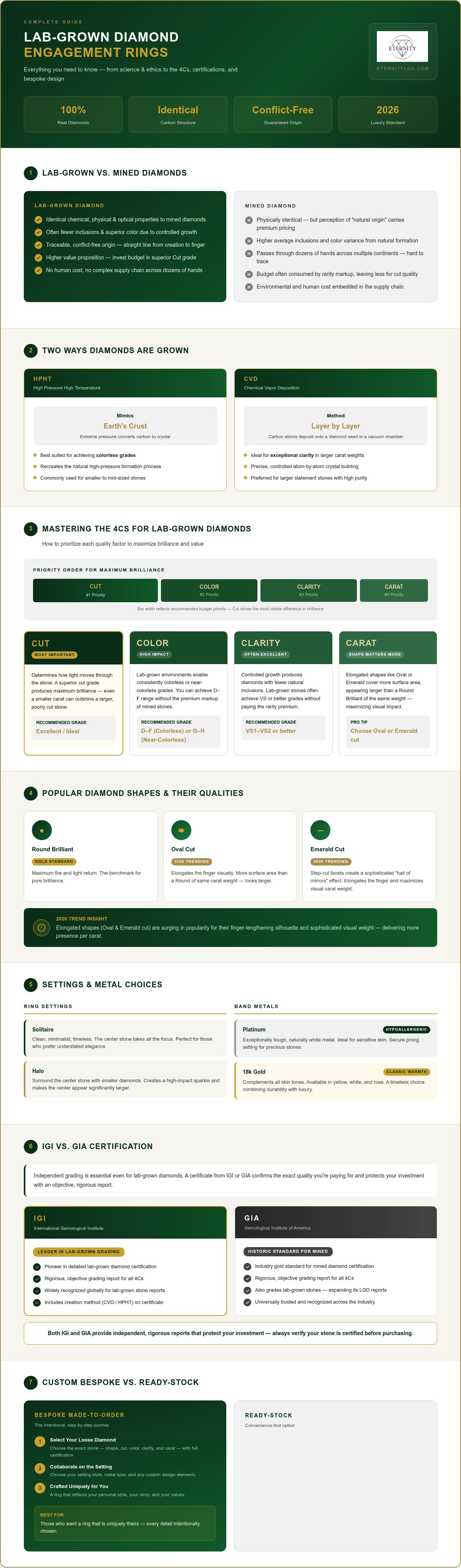
A diamond is defined by its atomic structure, not its origin. For years, a misconception lingered that laboratory-grown stones were somehow "simulated" or "synthetic" in a way that suggested they weren't the real thing. In reality, lab grown diamond engagement rings feature stones that are 100% real diamonds. They share the exact same chemical, physical, and optical properties as their mined counterparts. Every sparkle, every facet, and every bit of hardness is identical because the carbon structure is the same.
As we move through 2026, the definition of luxury is shifting. It's no longer enough for a ring to be beautiful; it must also be responsible. Modern couples are choosing "conscious luxury," where the stone’s history is as flawless as its appearance. Because these diamonds are grown in controlled environments, scientists can often produce stones with fewer inclusions and superior color compared to the average mined stone. You aren't just buying a diamond; you're buying the pinnacle of human innovation and a story you can be proud to tell.
The Science of Lab-Grown Diamonds: CVD vs. HPHT
Two primary methods bring these stones to life. High Pressure High Temperature (HPHT) recreates the crushing weight of the Earth's crust to transform carbon into a crystal. Chemical Vapor Deposition (CVD) uses a specialized vacuum chamber where carbon atoms "rain" onto a diamond seed, layering them one by one. These processes mimic the Earth's natural conditions without the environmental toll. The choice of method affects the final result; HPHT is often used to achieve colorless grades, while CVD allows for exceptional clarity in larger carat weights.
Why Ethical Sourcing is the New Standard for 2026
Transparency is the hallmark of modern fine jewelry. With traditional mining, a stone often passes through dozens of hands across multiple continents, making its true origin difficult to trace. Laboratory-grown diamonds offer a straight line from creation to your finger. This provides a natural "conflict-free" guarantee that doesn't rely on complex paperwork or vague promises. When you choose a lab-grown stone, you have the peace of mind that your symbol of love didn't come at a human or environmental cost. The result is a piece of jewelry that aligns your aesthetic tastes with your personal values.
Selecting Your Perfect Ring: Shapes, Settings, and the 4Cs
When you choose lab grown diamond engagement rings, the traditional 4Cs: Cut, Color, Clarity, and Carat, take on a new meaning. Because these stones offer a higher value proposition than mined diamonds, you can prioritize what actually matters: the light performance. We recommend focusing on the "Cut" above all else. A higher cut grade ensures the stone reflects light perfectly, giving you a brilliance that often outshines a larger, poorly cut stone.
Color and clarity also become easier to master when selecting lab grown diamond engagement rings. Laboratory environments allow for the creation of diamonds with exceptional purity, meaning you don't have to settle for visible inclusions or yellow tints. You can often secure a colorless (D-F) or near-colorless (G-H) stone that stays within your budget while looking absolutely flawless to the naked eye.
Navigating Diamond Shapes for Every Style
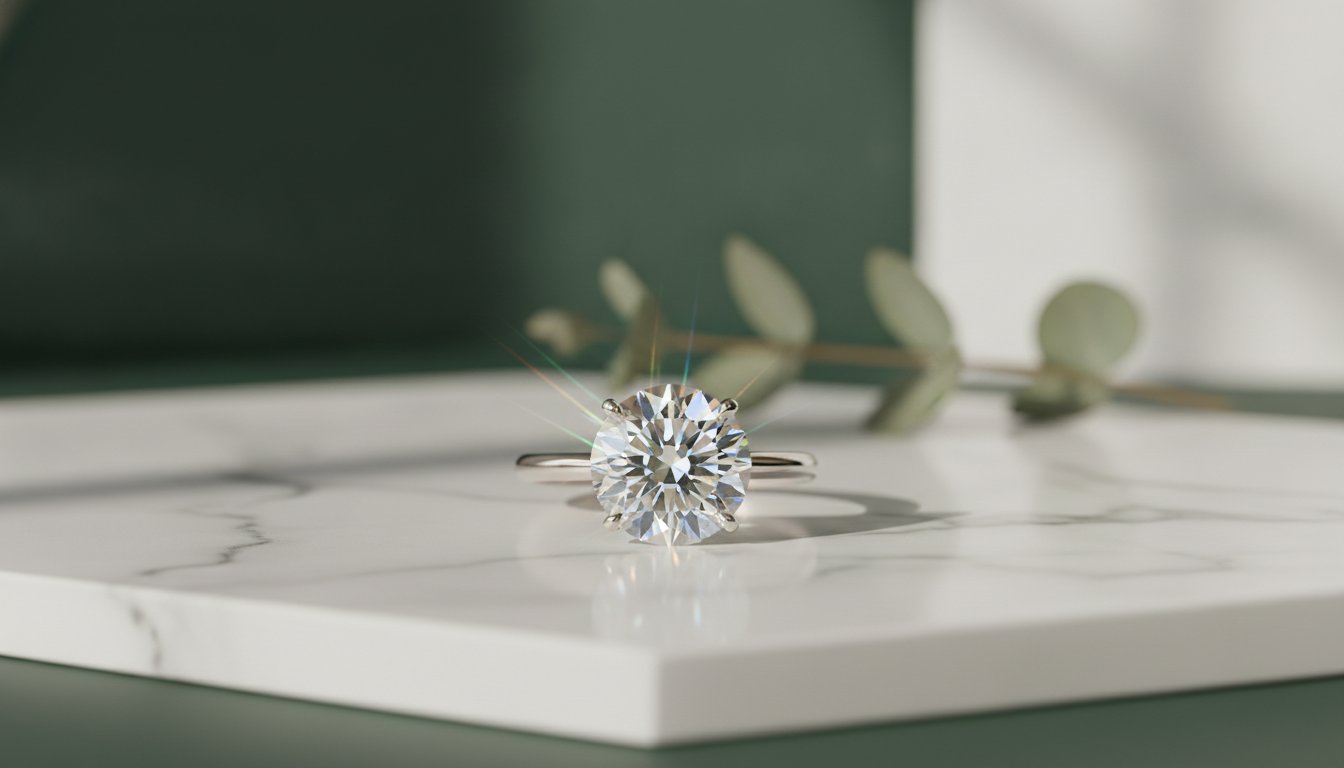
Choosing a shape is about balancing personal aesthetics with the visual impact on the hand. The Round Brilliant remains the gold standard for pure fire and light return. However, if you want to maximize the appearance of your carat weight, consider elongated shapes like the Oval or Emerald cut. These shapes cover more surface area on the finger, making the stone look larger than a round stone of the same weight. Current lab grown diamond jewelry trends for 2026 show a surge in these sophisticated, finger-lengthening silhouettes.
The setting you choose provides the architecture for your ring. For those who love a clean, minimalist look, the timeless solitaire remains a favorite. If you prefer high-impact sparkle, an intricate halo can make a center stone appear even more substantial. For the band, 18k gold and platinum are the preferred choices for durability. Platinum is exceptionally tough and hypoallergenic, making it ideal for sensitive skin, while 18k gold offers a classic warmth that complements various skin tones.
The Importance of IGI and GIA Certification
Confidence comes from verification. Even though lab-grown stones are real diamonds, independent grading is essential to confirm the quality you're paying for. The International Gemological Institute (IGI) and the Gemological Institute of America (GIA) are the industry leaders. While GIA is the historic standard for mined stones, IGI has led the way in detailed lab-grown grading for years. Both provide rigorous, objective reports that protect your investment. If you're ready to see these differences in person, browsing a curated selection of engagement rings can help you visualize your favorite combinations.
The Made-to-Order Journey: Custom vs. Ready-Stock Engagement Rings
Deciding how you acquire your ring is just as important as the stone itself. For many, "Ready-Stock" rings offer the perfect balance of convenience and quality. These are pre-set designs available for immediate delivery, making them ideal if your proposal timeline is tight. You still receive the same high-quality lab grown diamond engagement rings found in our custom catalog, but with the benefit of seeing the finished piece instantly.
On the other hand, the "Made-to-Order" path is for those who want to be active participants in the creative process. This journey begins with a loose diamond consultation. You select your specific stone from a curated catalog, ensuring the brilliance and dimensions align with your vision. From there, you move into the setting refinement stage, where every prong and curve is considered. This methodical approach ensures the final piece isn't just a product, but a reflection of your personal story.
Bespoke Design: Creating a Ring as Unique as Your Story
The beauty of custom lab grown diamond engagement rings lies in the details that only you know are there. Beyond the center stone, you can incorporate hidden engravings, unique basket designs, or specific metal finishes. This process transforms a piece of jewelry into a masterpiece that no one else in the world owns. It's a rewarding experience that bridges the gap between scientific innovation and deep emotional significance.
Choosing Between Custom and Ready-to-Wear
To decide which path is right for you, consider these three factors:
- Timeline: Custom designs typically require more time for craftsmanship and refinement. If you have a specific date in mind, plan at least several weeks in advance for the design and production cycle.
- Budget: While both options offer exceptional value, bespoke designs allow you to allocate your budget specifically toward a higher-grade stone or a complex, personalized setting.
- Design Specificity: If you have a very particular vision that isn't found in standard collections, the made-to-order route is essential to get every detail exactly right.
At Eternity LGD, both ready-stock and made-to-order options adhere to the same rigorous standards of ethical sourcing and technical precision. Whether you choose an immediate treasure or a bespoke creation, you're investing in a future where luxury and conscience coexist perfectly. Our role is to act as your trusted companion, ensuring the process is as brilliant as the diamond itself.
Your Journey Toward Conscious Luxury Starts Here
Choosing a diamond is no longer just about the sparkle; it's about the story that stone tells. We've explored how lab grown diamond engagement rings provide an identical physical and chemical structure to mined stones while offering a transparent, conflict-free origin. By focusing on superior cut and clarity, you can secure a masterpiece of modern science that fits your budget and your values perfectly.
Whether you choose the immediate beauty of a ready-stock design or the rewarding path of a bespoke creation, the result is a one-of-a-kind symbol of your commitment. Our team at Eternity LGD serves as your trusted companion throughout this process. We offer expert diamond consultations and ensure every stone is ethically sourced and independently certified. As specialists in made-to-order luxury jewelry, we prioritize your vision at every step of the design journey.
If you are ready to turn your inspiration into a physical reality, you can design your bespoke lab-grown diamond engagement ring at Eternity LGD today. We look forward to helping you create a piece that is as brilliant and enduring as your own unique story.
Frequently Asked Questions
Are lab-grown diamond engagement rings real diamonds?
Yes, lab grown diamond engagement rings feature 100% real diamonds. They consist of the same carbon atoms arranged in the same crystal structure as mined stones. Because they are chemically and physically identical, they share the same hardness and brilliance that defines a diamond. You aren't buying a lookalike; you're buying a genuine gemstone created through modern scientific innovation rather than geological pressure.
Do lab-grown diamonds have a resale value?
Lab-grown diamonds generally have a lower resale value than mined diamonds. While the secondary market is growing as adoption increases, most people buy them for their immediate value and ethical benefits rather than as a financial investment. It's best to view your ring as a meaningful symbol of your commitment rather than a liquid asset. The real value lies in the quality and size you can enjoy today.
How much cheaper are lab-grown diamond engagement rings compared to mined?
Lab grown diamond engagement rings are typically much more accessible than mined options. You can often expect to spend significantly less for a stone of the same size and quality, or choose a much larger, higher-grade diamond for the same budget. This price difference comes from the shorter supply chain and the efficiency of laboratory production, making high-end luxury reachable for a wider audience.
Will a lab-grown diamond engagement ring pass a diamond tester?
Yes, a lab-grown diamond will pass a diamond tester. Since they have the same thermal and electrical conductivity as mined diamonds, standard handheld testers will identify them as "diamond." Only specialized laboratory equipment used by professional gemologists can distinguish between the two by looking for specific growth patterns or trace elements that occur during the creation process.
How long does it take to create a custom lab-grown engagement ring?
Creating a custom ring usually takes several weeks from start to finish. This timeline includes the initial consultation, selecting your loose diamond, and the craftsmanship required for the setting. We recommend starting the process at least six to eight weeks before your planned proposal. This allows enough time for design refinements and ensures your one-of-a-kind piece is ready for your special moment.
Which certification is better for lab diamonds, IGI or GIA?
Both IGI and GIA are highly respected for their grading standards. IGI was one of the first major labs to provide full grading reports for lab-grown stones, making them a popular and trusted choice in the industry. GIA is also an excellent standard, offering rigorous testing that ensures your diamond's quality is accurately documented. Most experts agree that as long as your stone has a report from one of these two, you can be confident in its quality.
Disclaimer
The information provided in this article is for educational and informational purposes only and should not be considered professional financial, legal, investment, or gemological advice. While Eternity strives to ensure all information is accurate and up to date, diamond grading standards, market prices, industry practices, and product availability may change over time.
All opinions expressed are based on current industry knowledge and are intended to help consumers make informed decisions. Product specifications, pricing, promotions, and services may vary and are subject to change without notice.
Lab-grown diamonds sold by Eternity are independently graded by recognized laboratories such as IGI or GIA where applicable. We encourage customers to consult with our jewelry specialists for recommendations tailored to their individual needs before making a purchase.
© Eternity Inc. All rights reserved. This content may not be reproduced without written permission.