How to Measure Ring Size at Home Accurately
A ring can be beautifully designed, set with a brilliant lab-grown diamond, and made exactly to your vision - but it still needs to feel right the moment it slips onto the finger. Knowing how to measure ring size before ordering helps avoid an uncomfortable fit, protects delicate settings, and makes the experience of giving or receiving meaningful jewelry feel effortless.
The most reliable option is always an in-person professional measurement. Still, a careful at-home measurement can give you a strong starting point, especially when you are planning a custom ring, ordering a surprise gift, or comparing a ring you already own. The key is using the right method, measuring at the right time, and allowing for the ring’s design.
How to Measure Ring Size With a Ring You Own
If you have a ring that fits the intended finger comfortably, measuring its inside diameter is often the most accurate at-home approach. Choose a ring that is worn on the same hand and finger as the new piece. Ring sizes can differ from one finger to the next, and many people find their dominant hand is slightly larger.
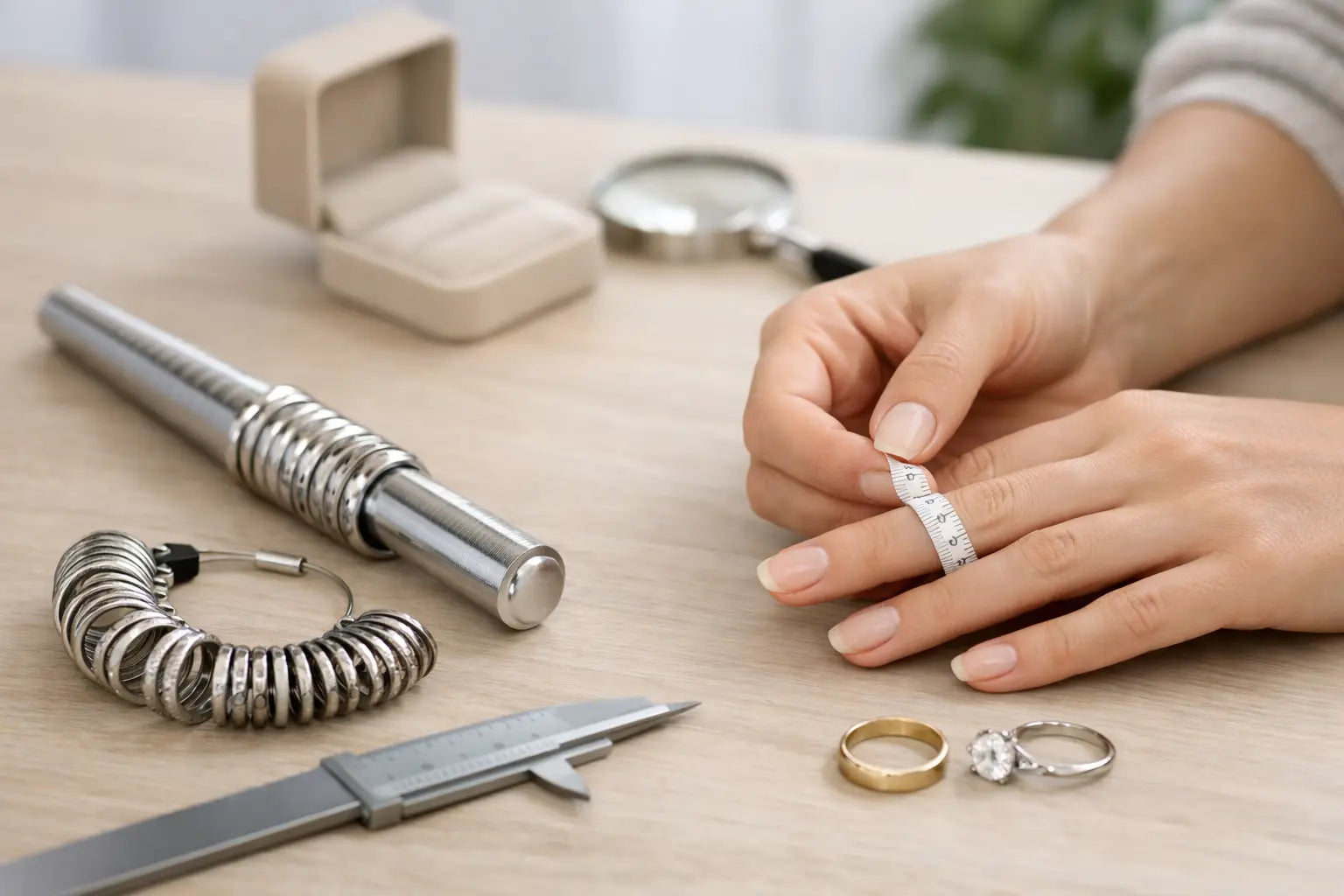
Lay the ring flat on a ruler with millimeter markings. Measure straight across the open space inside the band, from one inner edge to the other. Do not include the metal itself. That inside measurement is the diameter. For example, an inside diameter close to 16.5 millimeters generally corresponds to a US size 6, while roughly 17.3 millimeters is usually a size 7.
A printable ring-size guide can also help, but only if it prints at 100 percent scale. Before trusting the result, check the guide’s calibration mark with a ruler. Even a small printer-scaling change can turn a well-fitting ring into one that is too tight or loose.
This method works best with a round band. If the ring is bent, oval-shaped, or has a very wide design, its measurement may not translate perfectly to a new ring.
Use a Ring Sizer for the Best At-Home Result
A plastic adjustable ring sizer is inexpensive, easy to use, and generally more dependable than paper or string. It works much like a small belt around the finger. Slide it on, adjust it until it feels comfortable, then make sure it can pass over the knuckle with gentle resistance.
The correct fit should not spin freely or leave a deep mark after a short time. At the same time, it should not require force, soap, or cold water to remove. A ring needs to move over the knuckle while still resting securely at the base of the finger.
For an engagement ring or a made-to-order diamond ring, requesting a professional sizing tool is a smart extra step. It gives you a repeatable measurement and makes it easier to compare sizes if your finger falls between two options.
How to Measure Ring Size With String or Paper
String and paper are useful when you need a quick estimate, but they require more care because soft materials can stretch or compress. Use a thin strip of non-stretch paper or a piece of floss, rather than elastic string. Wrap it around the base of the finger without pulling it tight, mark the point where the ends meet, then lay it flat against a millimeter ruler.
That measurement is the finger’s circumference. You can compare the circumference to a US ring-size chart. As a general reference, a circumference of about 51.9 millimeters aligns with a size 6, and about 54.4 millimeters aligns with a size 7.
Repeat the process two or three times. If your measurements differ, do not automatically choose the smallest one. Consider whether the strip crossed the knuckle easily and whether your fingers were warm, cool, or swollen at the time. A paper measurement is an estimate, not a substitute for a properly fitted ring sizer.
Measure at the Right Time of Day
Finger size changes more than most people expect. Heat, exercise, travel, salty meals, hormonal changes, and even a long day at a keyboard can cause temporary swelling. Cold hands can produce a measurement that is smaller than your usual size.
For the most realistic reading, measure in the evening, when fingers are typically at their largest, and after you have been at a comfortable indoor temperature for a while. Avoid measuring immediately after a workout, a hot shower, or time outdoors in very cold weather.
If you receive two close measurements, measure again on another day. Consistency matters more than trying to force a single number. For a ring you plan to wear daily, the goal is a size that remains comfortable through ordinary changes in temperature and activity.
Do Not Forget the Knuckle
Some fingers are fairly even from base to knuckle. Others have a pronounced knuckle, which changes the sizing decision. In that case, measure both the base of the finger and the widest part of the knuckle. A good starting size is usually between those two measurements.
A ring that clears the knuckle but feels slightly loose at the base may benefit from sizing beads or another fit adjustment. These small details are worth discussing before production, particularly for a custom design that includes an intricate setting or engraved band.
Ring Width and Style Can Change the Fit
Two rings with the same numerical size may feel completely different on the hand. A slim solitaire band usually feels lighter and more forgiving than a wide wedding band. As the band gets wider, it covers more skin and tends to fit more snugly.
For bands around 6 millimeters or wider, many people prefer going up about a quarter or half size. It depends on the finger shape, the inner profile of the band, and personal comfort. A comfort-fit band has a gently rounded interior and may feel easier to wear than a flat interior band of the same width.
Design details matter, too. An eternity band with diamonds around the entire circumference often has limited resizing options, because changing the size can disrupt the stone setting and pattern. Open bands, delicate pavé designs, tension-style settings, and rings with elaborate side details can also be more complex to resize than a plain metal band.
That does not mean you should choose a larger size just to be safe. A ring that is too loose can rotate, expose the underside of the setting, or slip off in cold weather. Instead, share the actual measurements and the style you want with a jewelry expert before finalizing a made-to-order piece.
Measuring Ring Size for a Surprise Gift
A surprise engagement ring or anniversary gift calls for a different strategy. The easiest option is to borrow a ring the recipient already wears on the correct finger and measure its inside diameter. Be discreet, and make sure it is not a ring they wear on the other hand. A right-hand ring may not match the left-hand size.
If borrowing a ring is not possible, a close friend or family member may know the size or be able to help arrange a casual shopping trip where sizing feels natural. Guessing from shoe size, height, or clothing size is unreliable and can lead to a frustrating result.
When a surprise is essential, choose a design with a reasonable path to resizing if needed. A classic solitaire or a simple band is generally more adaptable than a full eternity ring. If you are choosing an eternity design for its continuous sparkle and symbolism, accurate sizing before production becomes especially valuable.
What to Do if You Are Between Ring Sizes
Being between sizes is common. Your best choice depends on the band’s width, how prominently your knuckle sits, and whether the ring will be worn alone or stacked. If the ring is narrow and your knuckle is modest, sizing down may provide a more secure fit. If the band is wide, your fingers swell often, or the ring needs to pass a larger knuckle, sizing up is usually more comfortable.
Stacking also changes the feel of a ring. An engagement ring worn beside a wedding band can feel tighter than either ring worn separately. If you are selecting both at once, try to account for the combined width rather than measuring for only one delicate band.
A final professional check brings welcome confidence, particularly for a proposal ring, wedding band, or custom lab-grown diamond design. It is a small moment of care that lets the finished piece feel as personal, considered, and lasting as the reason you chose it.