Understanding GIA Certified Lab Grown Diamonds: The 2026 Buyer’s Reference
The "perfect" 4Cs grade you’ve been searching for might not even exist on a modern laboratory report. Since the GIA shifted its grading structure in late 2025, the process of selecting gia certified lab grown diamonds has become a completely different experience for the conscious buyer. It’s understandable if you feel a sense of confusion while trying to compare stones across different platforms. You want the absolute certainty that your diamond is high-quality, but the move toward descriptive tiers can feel less precise than the traditional scales used for decades.
This 2026 reference guide will clarify exactly how these new GIA standards work and how they impact the long-term value of your jewelry. We’re here to help you interpret the "Premium" and "Standard" classifications so you can secure a stone that offers maximum brilliance without an inflated price tag. You deserve to feel like an active, informed participant in your creative journey rather than a spectator to complex industry jargon.
We will explore the technical nuances of the current market, provide a clear framework for comparing GIA reports against other labs, and offer professional guidance on selecting the ideal center stone for your made-to-order engagement ring or fine jewelry piece.
Key Takeaways
- Learn why GIA certification is the world’s most respected mark of scrutiny for ensuring consistency in lab-grown stone quality.
- Master a simple framework for reading a 2026 report to ensure you’re choosing gia certified lab grown diamonds that meet your specific standards.
- Discover how to use the GIA official database to verify your stone’s authenticity and protect your investment from the start.
- Understand how precise grading reports allow for the precision engineering required in high-end, made-to-order custom jewelry settings.
- Find out how to match color and clarity grades across multiple stones to create a cohesive look for pieces like bespoke tennis bracelets.
The Gold Standard: Why GIA Certification Matters for Lab-Grown Diamonds
The Gemological Institute of America (GIA) has long been the world's most respected nonprofit authority on diamond grading. When you choose gia certified lab grown diamonds, you're opting for a level of scrutiny that other labs simply don't match. Think of the GIA report as a definitive birth certificate for your stone. It confirms the diamond’s origin and any treatments it might have undergone. This transparency is vital for understanding what lab-grown diamonds are and ensuring you're getting exactly what you pay for.
To better understand how to verify your diamond's credentials, watch this helpful video:
The Evolution of GIA Lab-Grown Diamond Reports
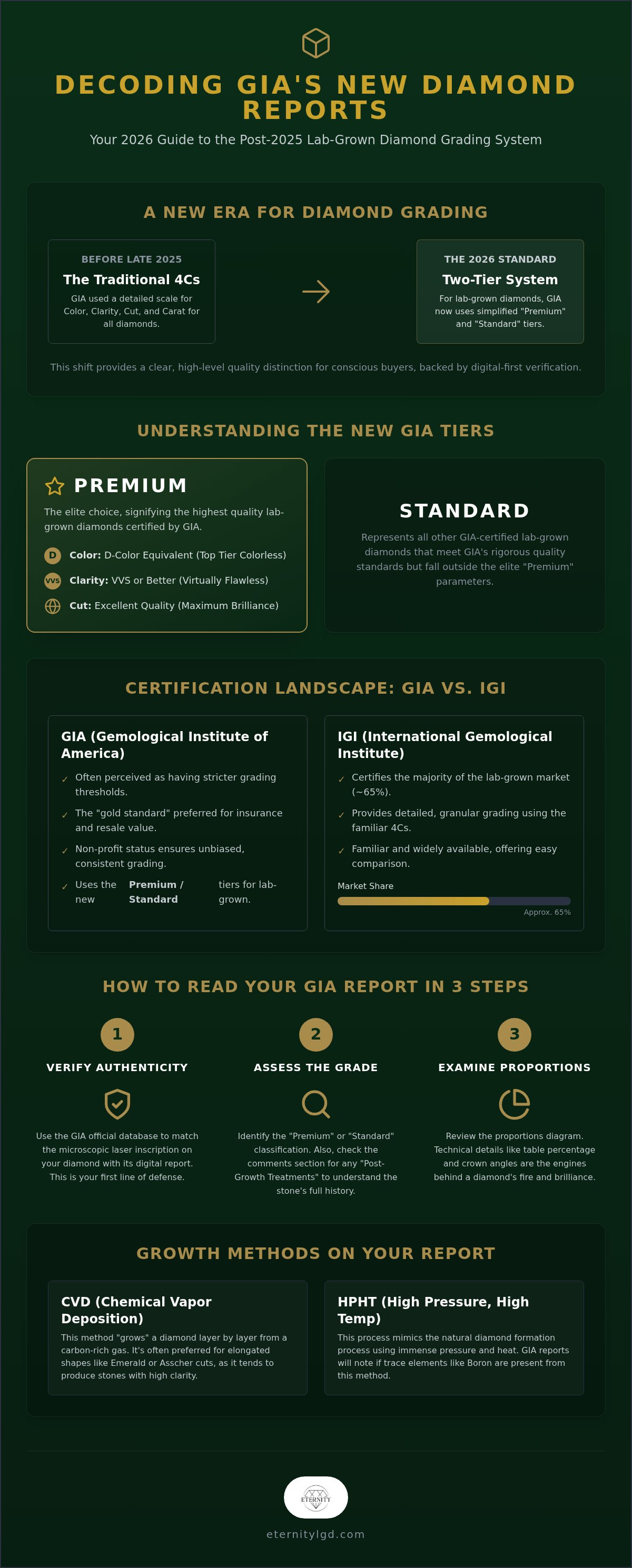
The landscape changed significantly on October 1, 2025. GIA moved away from the traditional 4Cs for lab-grown stones, introducing a two-tier system: Premium and Standard. A Premium grade signifies a stone with D-color equivalent, VVS clarity or better, and excellent cut quality. This digital-first approach in 2026 enhances your security by allowing instant database verification. Every stone also features a microscopic laser inscription on the girdle, linking the physical diamond directly to its digital record.
GIA vs. IGI: Navigating the 2026 Certification Landscape
While the International Gemological Institute (IGI) certifies about 65% of the lab-grown market, GIA remains the choice for those seeking a "premium" standard. IGI still uses the granular 4Cs grading, which many buyers find familiar and helpful for comparison. However, GIA's thresholds for color and clarity are often perceived as stricter. This reputation can influence several factors for your gia certified lab grown diamonds:
- Resale Value: GIA-certified stones often hold their perceived value better in the secondary market.
- Insurance: Many insurers prefer the authoritative data provided by GIA for appraisals.
- Consistency: GIA’s non-profit status ensures an unbiased look at every stone.
Choosing between them often depends on whether you prefer the detailed 4Cs of IGI or the elite prestige associated with GIA's rigorous standards. Both provide peace of mind, but GIA remains the definitive mark of trust for high-end custom jewelry.
Evaluating Quality: How to Read a GIA Lab-Grown Diamond Report
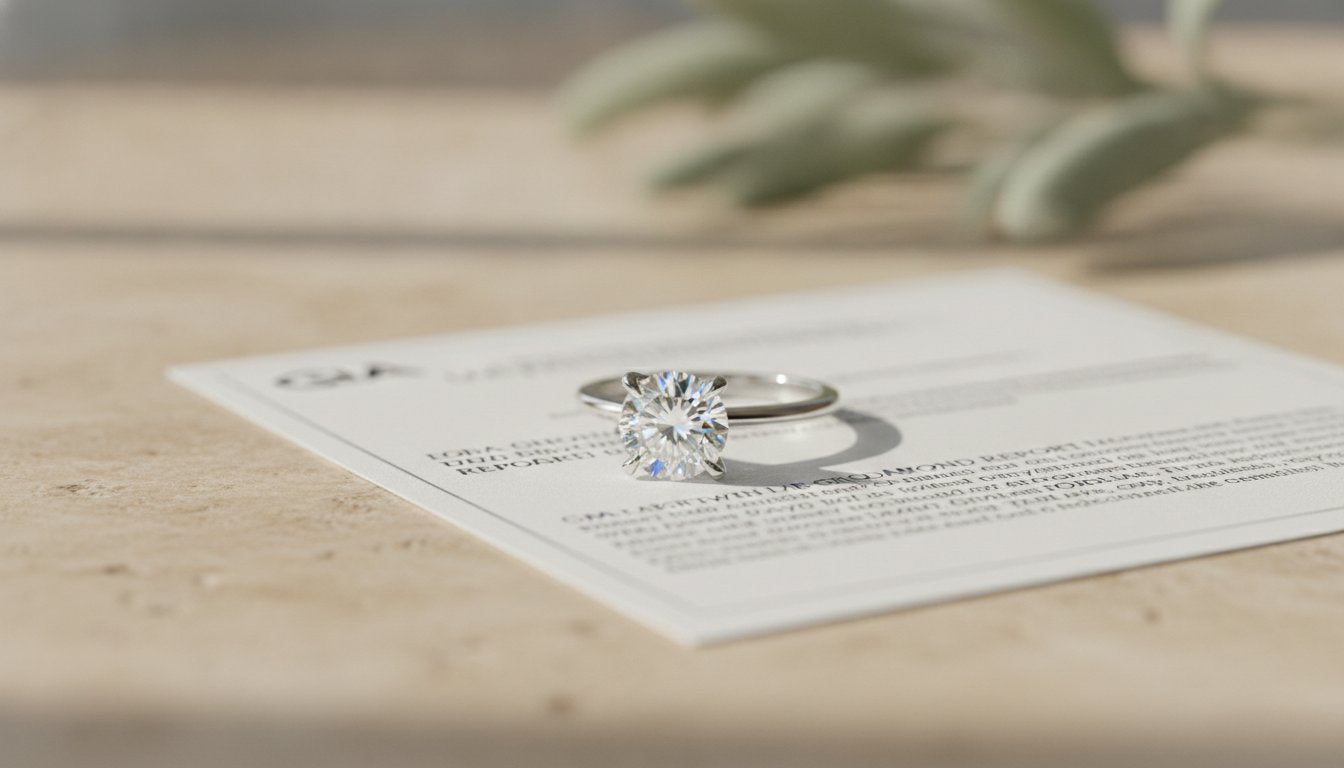
Reading a diamond report shouldn't feel like deciphering a secret code. It's a logical process designed to give you absolute confidence in your purchase. To get the most out of your gia certified lab grown diamonds, start by verifying the report number on the GIA official database. This simple step ensures the digital record matches the physical stone in your hand. It's your first line of defense against misrepresentation.
Next, analyze the grading tiers. As of late 2025, GIA simplified its lab-grown reporting. Instead of the traditional 4Cs scale, you'll see stones classified as "Premium" or "Standard." A Premium grade is the elite choice. It indicates a D-color equivalent, VVS clarity or better, and an excellent cut. You should also check the technical comments for "Post-Growth Treatments." Some stones undergo additional processes to enhance their color. While these treatments are stable, knowing if a stone is "as-grown" adds another layer of transparency to your selection.
Finally, review the proportions diagram. This technical map shows the stone’s table percentage and crown angles. These measurements are the true engines behind a diamond’s fire and light performance. If you're feeling overwhelmed, you can consult with our experts to help translate these technical specs into real-world beauty.
Identifying Growth Methods: CVD vs. HPHT on your Report
GIA reports clearly state whether a stone was created via Chemical Vapor Deposition (CVD) or High Pressure High Temperature (HPHT). This distinction matters for specific shapes. CVD is often preferred for elongated step-cuts like Emerald or Asscher shapes because the growth process tends to avoid certain metallic inclusions. HPHT stones sometimes involve trace elements like Boron, which can occasionally result in a faint blue tint. Identifying these methods helps you pick a stone that fits your specific jewelry design.
Fluorescence and Polish: The Hidden Details of Lab Quality
For high-end custom jewelry, "Excellent" grades for symmetry and polish are non-negotiable. These details ensure that light reflects perfectly off every facet. Unlike mined stones, fluorescence is incredibly rare in lab-grown diamonds, which usually results in a crisper appearance. Choosing loose diamonds for custom jewelry allows you to hand-select stones that meet these rigorous technical standards before they are ever set in metal.
Selecting GIA Certified Diamonds for Custom Bespoke Jewelry
Certification isn't just a mark of quality; it's the technical blueprint for the physical construction of your piece. When you select gia certified lab grown diamonds, you provide your jeweler with exact millimeter measurements and depth percentages. This granular data allows for precision-engineered custom settings that protect the stone while maximizing its light performance. A master craftsman can use these specs to create a mount that fits the diamond like a glove, ensuring durability for a lifetime of wear.
If you're designing a lab grown diamond tennis bracelet, consistency is your highest priority. The GIA report ensures that every stone in the piece matches perfectly in color and clarity. This prevents a single diamond from looking "off" or slightly yellowish when viewed against the others in the row. Beyond aesthetics, a certified stone is the cornerstone of a sustainable luxury investment. It provides the necessary documentation to secure accurate insurance appraisals for your bespoke piece, protecting your financial interest as well as your sentimental one.
Matching Diamonds to Made-to-Order Settings
A diamond's depth percentage is crucial for specific ring designs. For instance, a low-profile ring requires a stone that isn't too "deep," or it will sit awkwardly high on the finger. By using the GIA report, you can identify stones that are "eye-clean" to the naked eye but might have a slightly lower clarity grade on paper. This savvy approach helps you save on your budget without sacrificing the final beauty of the piece. We recommend discussing these technical details during the custom engagement ring design process to ensure your vision and the stone's specs align perfectly.
The 2026 Value Proposition: Longevity and Verification
As the market for lab-grown stones continues to grow, GIA certification will play a vital role in the emerging pre-owned market. It offers the peace of mind that your diamond is chemically identical to a mined stone while serving as a verified record of its ethical origin. Before you finalize your purchase, use this quick checklist to ensure total confidence:
- Does the laser inscription on your gia certified lab grown diamonds match the digital report?
- Has your jeweler explained how the stone's depth will affect your chosen setting?
- Are the color grades consistent across all stones if you're building a multi-stone piece?
- Have you verified the report number on the official GIA database?
Building Your Legacy with Confidence
Choosing a center stone for your jewelry is a significant milestone that blends scientific innovation with personal expression. By prioritizing gia certified lab grown diamonds, you're selecting a stone that has passed the industry's most rigorous scrutiny. This ensures your piece isn't just beautiful today; it's backed by a verifiable digital record that maintains its integrity and value for years to come.
A high-quality report serves as the essential technical guide for your bespoke setting. Whether you're matching color grades for a tennis bracelet or selecting a single brilliant gem for an engagement ring, GIA data ensures a perfect fit. We're here to help you navigate these complex choices with ethical transparency and master craftsmanship. Our team provides access to a vast global catalog of GIA and IGI certified stones, ensuring your sourcing is as conscious as it is refined.
Consult with our experts to find your perfect GIA certified diamond through our personalized, step-by-step consultation process. You're ready to begin your creative journey and create something truly exceptional.
Frequently Asked Questions
Are GIA certified lab diamonds more expensive than IGI certified ones?
GIA certified lab diamonds often carry a slight price premium compared to those with IGI reports. This difference reflects the GIA’s reputation for maintaining the industry's strictest grading thresholds and their long-standing status as a nonprofit authority. While the physical diamond's quality is the primary driver of cost, many buyers find that the added layer of scrutiny provided by a GIA report justifies the small additional investment.
Can I verify my GIA lab-grown diamond report online?
You can verify your report instantly through the GIA Report Check tool on their official website. Since the GIA transitioned to digital-first reporting in late 2025, you simply enter the unique report number laser-inscribed on the diamond's girdle. This provides a secure and transparent way to confirm that your gia certified lab grown diamonds match the official laboratory records perfectly.
Do GIA certified lab diamonds look different from mined diamonds?
No, GIA certified lab diamonds are chemically, physically, and optically identical to mined diamonds. Even a professional jeweler cannot tell the difference with the naked eye or a standard loupe. The GIA uses advanced spectroscopic equipment to identify their origin; this ensures every stone is correctly labeled while maintaining the exact same fire and brilliance as a natural gem.
Is a GIA report necessary for insurance on lab-grown jewelry?
While not strictly mandatory, a GIA report is highly recommended for securing an accurate insurance appraisal. Most insurance providers prefer reports from recognized authorities to establish the stone's replacement value with total certainty. Having this documentation ensures that your bespoke jewelry is covered for its true quality; it also provides a clear path for replacement if the piece is ever lost or damaged.
Disclaimer
The information provided in this article is for educational and informational purposes only and should not be considered professional financial, legal, investment, or gemological advice. While Eternity strives to ensure all information is accurate and up to date, diamond grading standards, market prices, industry practices, and product availability may change over time.
All opinions expressed are based on current industry knowledge and are intended to help consumers make informed decisions. Product specifications, pricing, promotions, and services may vary and are subject to change without notice.
Lab-grown diamonds sold by Eternity are independently graded by recognized laboratories such as IGI or GIA where applicable. We encourage customers to consult with our jewelry specialists for recommendations tailored to their individual needs before making a purchase.
© Eternity Inc. All rights reserved. This content may not be reproduced without written permission.