Lab Grown Diamonds Price Guide: Navigating Value and Ethics in 2026
Did you know the wholesale price index for lab-grown diamonds has plummeted by 96% since 2018? This dramatic shift has turned the jewelry industry upside down, leaving many buyers feeling understandably overwhelmed. You want a piece that reflects your values, but the massive gaps in the lab grown diamonds price across retailers can make it feel like there's a hidden catch. It’s natural to worry about whether your stone will hold its perceived value or if you’re paying too much for technical specs you don’t fully understand.
This guide unlocks the secrets of 2026 pricing so you can secure the highest quality sparkle for your budget. We’ll demystify CVD versus HPHT growth, explain the new GIA "Premium" and "Standard" grading tiers, and show why a made-to-order approach provides superior value over ready-stock options. You’ll gain a clear framework to choose your next diamond with total confidence.
Key Takeaways
- Shift your perspective from diamond scarcity to technological precision to understand how modern production drives 2026 market value.
- Evaluate how CVD and HPHT growth methods influence the final lab grown diamonds price, helping you choose the right process for your specific budget.
- Master the "sweet spot" strategy by focusing on visual perfection and super-ideal cuts rather than paying for high-tier clarity grades that the naked eye cannot see.
- Discover why a made-to-order approach offers a more ethical and cost-effective path to luxury compared to traditional ready-stock jewelry.
Understanding the Factors Influencing Lab Grown Diamonds Price in 2026
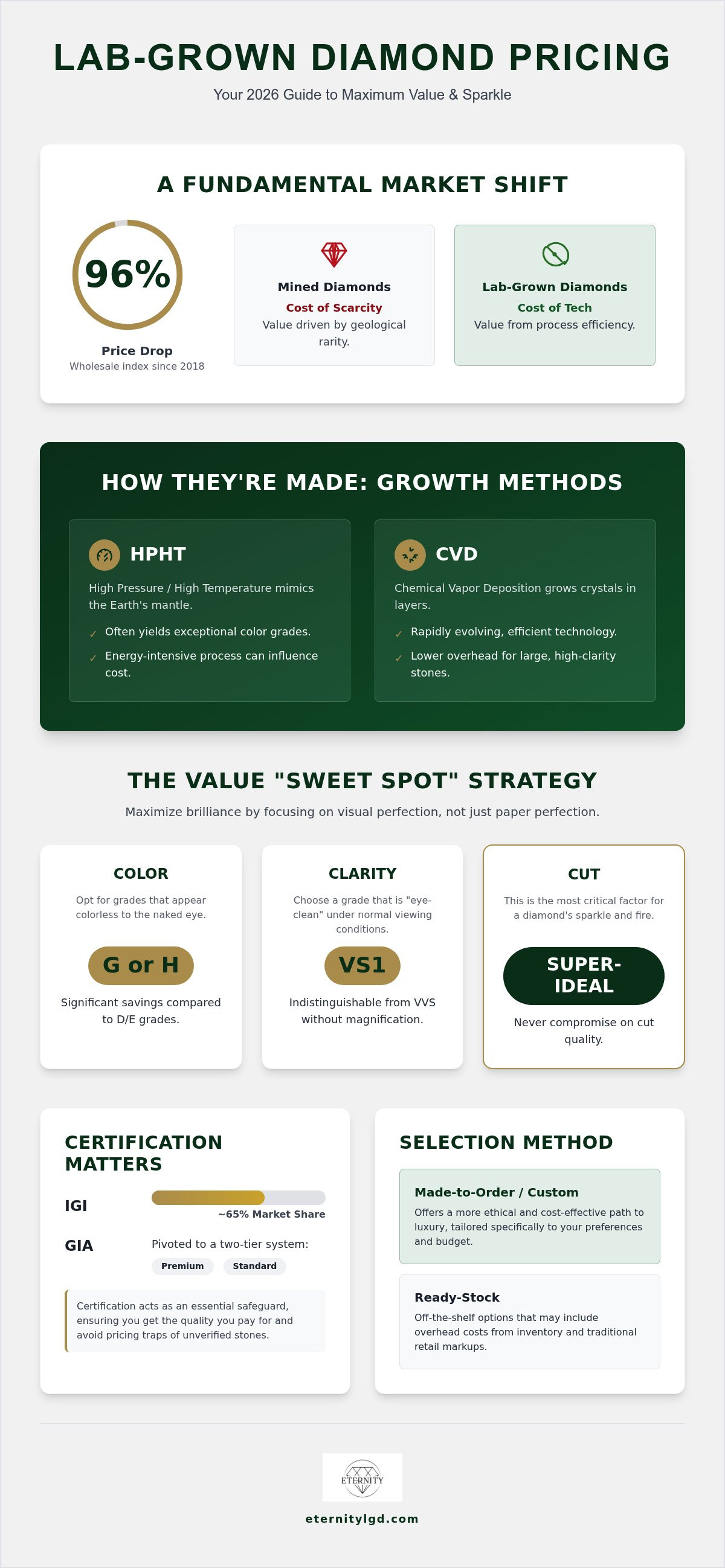
The traditional jewelry market relies on "Cost of Scarcity," where prices are driven by the rarity of geological discovery. However, the lab grown diamonds price follows the "Cost of Tech." This means that as laboratory efficiency improves and energy costs stabilize, the savings are passed directly to you. A synthetic diamond isn't a cheap imitation; it's a masterpiece of modern engineering where value is determined by the precision of the growth process.
To better understand how these market dynamics shift over time, watch this helpful video:
Two primary methods dominate the 2026 landscape: CVD and HPHT. High Pressure High Temperature (HPHT) mimics the earth's mantle, often yielding stones with exceptional color, though the energy-intensive process can keep costs higher for top-tier colors. Chemical Vapor Deposition (CVD) has evolved rapidly, allowing for the growth of massive, high-clarity crystals with lower overhead, which has significantly lowered the price floor for stones over two carats. It's a common misconception that a lower price tag implies a compromise in durability or brilliance. In reality, the lab grown diamonds price is simply a reflection of laboratory efficiency and energy costs.
Certification Standards: Why IGI vs GIA for Lab Diamonds Matters
The choice between IGI vs GIA for lab diamonds significantly influences market liquidity. IGI remains the dominant force, grading roughly 65% of the market with the familiar 4Cs scale. GIA has pivoted to a two-tier "Premium" and "Standard" system, which can simplify the choice for some but leaves others wanting more granular detail. While a certified stone carries a small premium, it acts as an essential safeguard for your purchase. Uncertified stones are often a pricing trap, as they lack the independent verification needed to ensure you aren't overpaying for a lower-grade gem.
Maximizing Your Investment: The Value "Sweet Spot" Strategy
Finding the best value requires distinguishing between "Paper Perfection" and "Visual Perfection." While a D-Flawless stone looks impressive on a certificate, it's often indistinguishable from slightly lower grades to the naked eye. The GIA Laboratory-Grown Diamond Quality Assessment provides a rigorous look at these attributes, but the real value lies in the "Sweet Spot." This involves choosing specifications that maximize brilliance while keeping the lab grown diamonds price within a reasonable range.
Unlike mined diamonds where hitting the 2.00-carat mark triggers a massive price spike due to rarity, lab environments allow for precise growth control. This means the traditional 1.99-carat versus 2.00-carat gap is much narrower; in fact, prices for 2-carat stones fell by 20% in the second quarter of 2026 alone. When evaluating man made diamond rings, focus on the stone-to-setting price ratio. A high-performance stone deserves a setting that complements its light return without overshadowing the gem's natural fire.
Decoding the 4Cs: Where to Save and Splurge
Strategic selection allows you to maximize your budget without sacrificing beauty. Follow this framework for 2026:
- Color: Opt for "G" or "H" grades. These appear colorless in most settings, especially in yellow gold, and significantly lower the total cost compared to "D" or "E" alternatives.
- Clarity: VS1 is the modern favorite. It's eye-clean and indistinguishable from VVS grades under normal conditions, allowing you to reallocate funds toward a larger stone.
- Cut: Never compromise here. A "Super-Ideal" cut is the engine of a diamond's sparkle. A poorly cut stone will look dull regardless of the lab grown diamonds price.
If you're ready to see how these specs look in person, you can explore our loose diamond collection for a transparent look at quality.
Custom vs. Ready-Stock: How Selection Impacts Total Cost
Choosing between off-the-shelf and bespoke options significantly impacts the final lab grown diamonds price. A detailed analysis of lab produced diamonds rings shows that ready-stock items often carry markups to cover inventory holding costs and retail overhead. By contrast, a made-to-order model eliminates these inefficiencies. This allows you to invest more of your budget into the stone's quality rather than the jeweler's shelf space. This transparent approach aligns with the FTC Jewelry Guides, which maintain the legal standards for marketing and disclosure. A professional diamond consultation is vital here. It prevents expensive mistakes by guiding you toward stones that offer the best visual impact for your specific setting. Additionally, custom manufacturing ensures the setting is perfectly optimized for the stone’s specific dimensions, creating a seamless and secure bond.
The Eternity Difference: Bespoke Craftsmanship and Sustainable Value
Designing a lab diamond bracelet offers a unique opportunity for precise budget allocation across multiple stones. You can select a uniform grade for every gem to ensure a cohesive sparkle that ready-stock pieces often lack. Beyond the immediate lab grown diamonds price, we prioritize long-term value through ethical sourcing and a commitment to sustainable luxury. We encourage you to use our sizing tools to ensure a perfect fit. This simple step reduces the need for future alterations and ensures your piece remains a comfortable, timeless staple of your collection.
Secure Your Dream Sparkle with Confidence
Choosing the perfect diamond is no longer about navigating artificial scarcity; it's about embracing technological precision and ethical transparency. By focusing on the "sweet spot" of visual perfection and prioritizing made-to-order craftsmanship, you ensure every dollar of the lab grown diamonds price supports the quality of your stone. We believe luxury should be approachable. Our transparent process uses IGI and GIA certified stones and a commitment to sustainable and ethical sourcing to eliminate retail markups. This approach puts master craftsmanship directly within your reach.
If you're ready to design a piece that reflects your values, Explore our Made-To-Order Lab Diamond Collection. You can also book a complimentary diamond consultation to find a gem that truly shines. Your journey toward a more brilliant, conscious future starts today.
Frequently Asked Questions
Why are lab grown diamonds so much cheaper than mined diamonds in 2026?
Lab grown diamonds cost less because they are produced through efficient technology rather than expensive geological exploration. By 2026, the lab grown diamonds price has reached a plateau as production methods like CVD have matured. This shift moves the value from scarcity to innovation. You're paying for laboratory energy and skilled craftsmanship rather than the high overhead of global mining logistics.
Do lab grown diamonds lose their value over time?
Lab grown diamonds maintain their intrinsic value as durable gemstones, though they shouldn't be viewed as speculative investments. Like most luxury goods, their resale market is still evolving. However, the lower initial lab grown diamonds price allows you to enjoy a larger, higher-quality stone today without the steep scarcity premium associated with mined diamonds, providing immediate lifestyle value and ethical peace of mind.
Is there a price difference between CVD and HPHT diamonds?
Yes, there is often a slight price variation based on the complexity of the growth method. HPHT diamonds frequently yield better color grades but require more energy; this can lead to a higher cost for top-tier stones. CVD technology has become more cost-efficient for larger carat weights in recent years. Choosing between them depends on your specific priorities for color versus clarity within your budget.
How much should I expect to pay for a 2-carat lab grown diamond?
While specific costs vary by retailer and certification, industry data from early 2026 shows that high-quality 2-carat stones have become significantly more accessible. Prices for these larger gems fell by approximately 20% in the second quarter of 2026. You'll find the best value by focusing on stones with Super-Ideal cuts and eye-clean clarity, ensuring your investment prioritizes visible brilliance over paper perfection.
Disclaimer
The information provided in this article is for educational and informational purposes only and should not be considered professional financial, legal, investment, or gemological advice. While Eternity strives to ensure all information is accurate and up to date, diamond grading standards, market prices, industry practices, and product availability may change over time.
All opinions expressed are based on current industry knowledge and are intended to help consumers make informed decisions. Product specifications, pricing, promotions, and services may vary and are subject to change without notice.
Lab-grown diamonds sold by Eternity are independently graded by recognized laboratories such as IGI or GIA where applicable. We encourage customers to consult with our jewelry specialists for recommendations tailored to their individual needs before making a purchase.
© Eternity Inc. All rights reserved. This content may not be reproduced without written permission.