Article: How to Choose Wedding Band Width for Your Hand
How to Choose Wedding Band Width for Your Hand
A wedding band may look like the simplest piece of your wedding jewelry, but its width changes almost everything: how it feels, how it complements an engagement ring, and how it looks on your hand years from now. To choose wedding band width with confidence, look beyond a single “standard” measurement and consider your finger shape, daily routine, preferred metal, and the visual weight of the rings you will wear together.
The best width is not necessarily the widest, the most delicate, or the one someone else chose. It is the one that feels natural on your hand while expressing the style you want your ring to have.
What Wedding Band Width Means
Band width is the measurement across the top of the ring, from one edge to the other. It is usually measured in millimeters. Even a difference of 1 millimeter can noticeably change the look and feel of a wedding band.
For many women’s wedding bands, widths around 1.5 mm to 3 mm are common. Men’s wedding bands often range from 4 mm to 8 mm, though there is no rule that says a woman must wear a narrow band or a man must wear a wide one. Modern wedding jewelry is personal. A slim polished band can feel refined and understated on any hand, while a substantial diamond-set band can create a strong, fashion-forward look.
Width should also be considered separately from thickness. Width is what you see from above. Thickness is how much metal sits between your finger and the outer surface of the ring. A ring can be wide but relatively low-profile, or narrow with a rounded, thicker shape. Both measurements affect comfort.
Choose Wedding Band Width Based on Your Hand
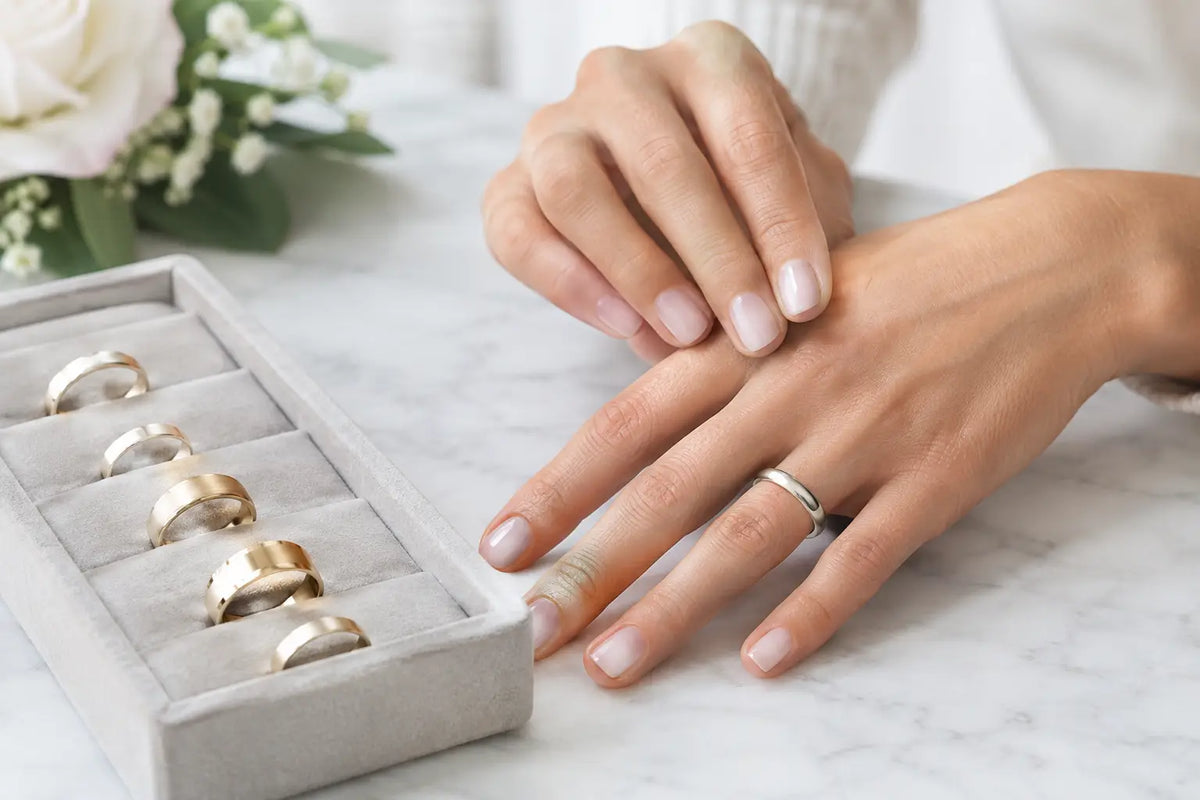
Your hand proportions can help narrow the choices, but they should guide rather than limit you. Trying on several widths is especially helpful because a millimeter looks very different on a display tray than it does on your finger.
For petite hands or shorter fingers
Narrow to medium bands often create an elegant, lengthening effect. A width between 1.5 mm and 3 mm can provide enough presence without visually overwhelming the finger. This is particularly true when the band will sit beside an engagement ring with a delicate setting or a center stone that deserves to remain the focal point.
That said, a wider band can still look beautiful on petite hands when it has a low profile or a clean, minimal design. A 4 mm satin-finish band, for example, may feel bolder without appearing heavy.
For longer fingers or larger hands
Medium and wide bands often feel balanced on longer fingers. Widths of 3 mm to 5 mm can provide a noticeable presence for a diamond band, while 6 mm or wider can make a confident statement in a plain metal style.
If you have longer fingers but love a narrow band, follow your preference. You may simply want to pair it with an engagement ring that has enough visual weight to keep the set feeling intentional.
For wider fingers or larger knuckles
A slightly wider band can create a balanced, comfortable appearance, especially when paired with a rounded comfort-fit interior. Extremely thin bands may feel less substantial or may rotate more noticeably throughout the day.
Finger size does not determine what you can wear. It simply changes proportion. The ring should make you feel polished and comfortable, not restricted by a sizing formula.
Match the Band to Your Engagement Ring
If you plan to wear your wedding band every day with an engagement ring, look at them as a set from the beginning. Matching widths is a classic choice, but it is not the only one.
A wedding band that closely matches the width of the engagement ring shank creates a cohesive, traditional look. For example, a 2 mm engagement ring often pairs beautifully with a 2 mm or 2.5 mm band. This approach works especially well with solitaire settings, pavé engagement rings, and simple diamond bands.
A contrasting width can be just as considered. A slender engagement ring paired with a slightly wider plain band can add dimension and make the stack feel more modern. Conversely, a wider engagement ring can look striking beside a fine, diamond-accented wedding band.
Pay attention to the setting height and shape, too. Some engagement rings sit flush against a straight band, while others need a curved or notched band to avoid a gap. A contour band may be the right choice when the center setting extends low over the finger. Custom design can be valuable here because it allows the curve, width, metal, and diamond details to be created around your exact engagement ring.
Comfort Matters More Than You Think
A wedding band is designed for real life: workdays, travel, celebrations, errands, and quiet weekends at home. The width you choose should feel good during all of it.
Wider bands cover more of the finger, which some people love because they feel secure and substantial. Others find a wide ring takes time to get used to, particularly if they have never worn rings regularly. Narrow bands are generally lighter and less noticeable, but a very thin band may not deliver the presence you want or support the design details you have in mind.
The ring’s profile matters as much as its width. A comfort-fit band has a gently rounded interior, reducing the amount of metal that presses against the finger. This is often a smart choice for bands 4 mm and wider, though many people enjoy it in every width.
Try rings on later in the day if possible, when fingers may be slightly fuller. You should be able to bend your finger comfortably and remove the ring with gentle resistance. A proper fit helps you assess width honestly instead of judging only how a ring looks in a brief try-on.
Consider Your Lifestyle and Maintenance Preferences
Your lifestyle can influence the most practical wedding band width. If you work with your hands, exercise often, or prefer jewelry that is easy to wear without much thought, a low-profile plain metal band may be an ideal choice. A medium width can offer durability while keeping the design streamlined.
For diamond wedding bands, wider is not always better. More width can create room for larger diamonds, multiple rows, or detailed settings, but it also means more surface area to care for. A slender pavé band offers sparkle with a lighter look, while a wider channel-set or bezel-set diamond band can feel more protected for frequent wear.
Metal choice also changes the visual effect. Yellow gold tends to appear warm and distinct, so a 3 mm yellow gold band may look more prominent than the same width in platinum or white gold. Rose gold brings softness and contrast, especially beside a white metal engagement ring. Seeing your preferred width in your selected metal is worth the extra step.
Decide How Much Presence You Want
Before focusing on measurements, ask a simpler question: Do you want your wedding band to blend in, add sparkle, or stand on its own?
A 1.5 mm to 2 mm band often feels delicate and quietly elegant. It is a natural choice for someone who wants an engagement ring to remain center stage. A 2.5 mm to 4 mm band has more visual presence and works well for those who want their wedding ring to be clearly visible, whether it is plain metal or diamond-set. Bands 5 mm and wider read as bold and architectural, particularly in polished, brushed, hammered, or matte finishes.
If you are building a stack, consider the combined width rather than each ring in isolation. Three narrow rings can cover as much finger space as one wide band. This can look intentional and expressive, but it may feel crowded if you prefer a lighter, less noticeable fit.
Do Not Forget Future Style Changes
Your wedding band will carry memories, but it can also evolve with your style. Some people begin with a slim classic band and add an anniversary ring later. Others choose a wider diamond band from the start because they want one meaningful ring with enough presence to wear alone.
A versatile choice is a band that looks complete by itself and still complements your engagement ring. This matters on days when you may leave your engagement ring at home, travel, or simply want a more minimal look.
For a custom wedding band, bring photos and measurements of your engagement ring to the design conversation. Details such as the shank width, setting height, center stone shape, and side-stone placement can all affect the right band width and contour. At Eternity LGD, a personalized design process can help turn those technical details into a ring that feels distinctly yours.
The right wedding band width should feel considered, not calculated. Try the widths that appeal to you, look at them beside your engagement ring, and give yourself permission to choose the one that makes you glance down at your hand and smile.