Lab Diamonds Versus Moissanite: Which Fits?
The difference between a ring you admire online and one you want to wear every day often comes down to light. In the conversation around lab diamonds versus moissanite, both stones can look bright, colorless, and impressive from across a room. Up close, however, they have distinct material properties, sparkle patterns, price points, and emotional associations.
For an engagement ring, anniversary gift, or custom piece you plan to keep close for years, the better choice is not simply the less expensive one or the larger one. It is the stone that matches how you want your jewelry to look, feel, and represent your story.
Lab Diamonds Versus Moissanite: The Essential Difference
A lab-grown diamond is a diamond. It has the same chemical composition - carbon - and the same crystal structure, hardness, and optical properties as a mined diamond. The difference is origin: it is grown in a controlled laboratory rather than formed beneath the earth over geological time. Like mined diamonds, lab-grown diamonds can be evaluated for cut, color, clarity, carat weight, and, when applicable, an independent grading report.
Moissanite is a different gemstone, made of silicon carbide. Natural moissanite is extremely rare, so nearly all moissanite used in fine jewelry is created in a laboratory. It is not a diamond substitute in the sense of being a diamond with a different origin. It is its own gemstone, with its own visual personality.
That distinction matters because two stones may look similar in a product photo while behaving differently in daylight, under restaurant lighting, and at close viewing distance. If you want the classic look and physical identity of a diamond, a lab-grown diamond delivers that without the mining origin. If you love bold, high-energy flashes of color and want to maximize size at a lower cost, moissanite may be compelling.
How Their Sparkle Looks in Real Life
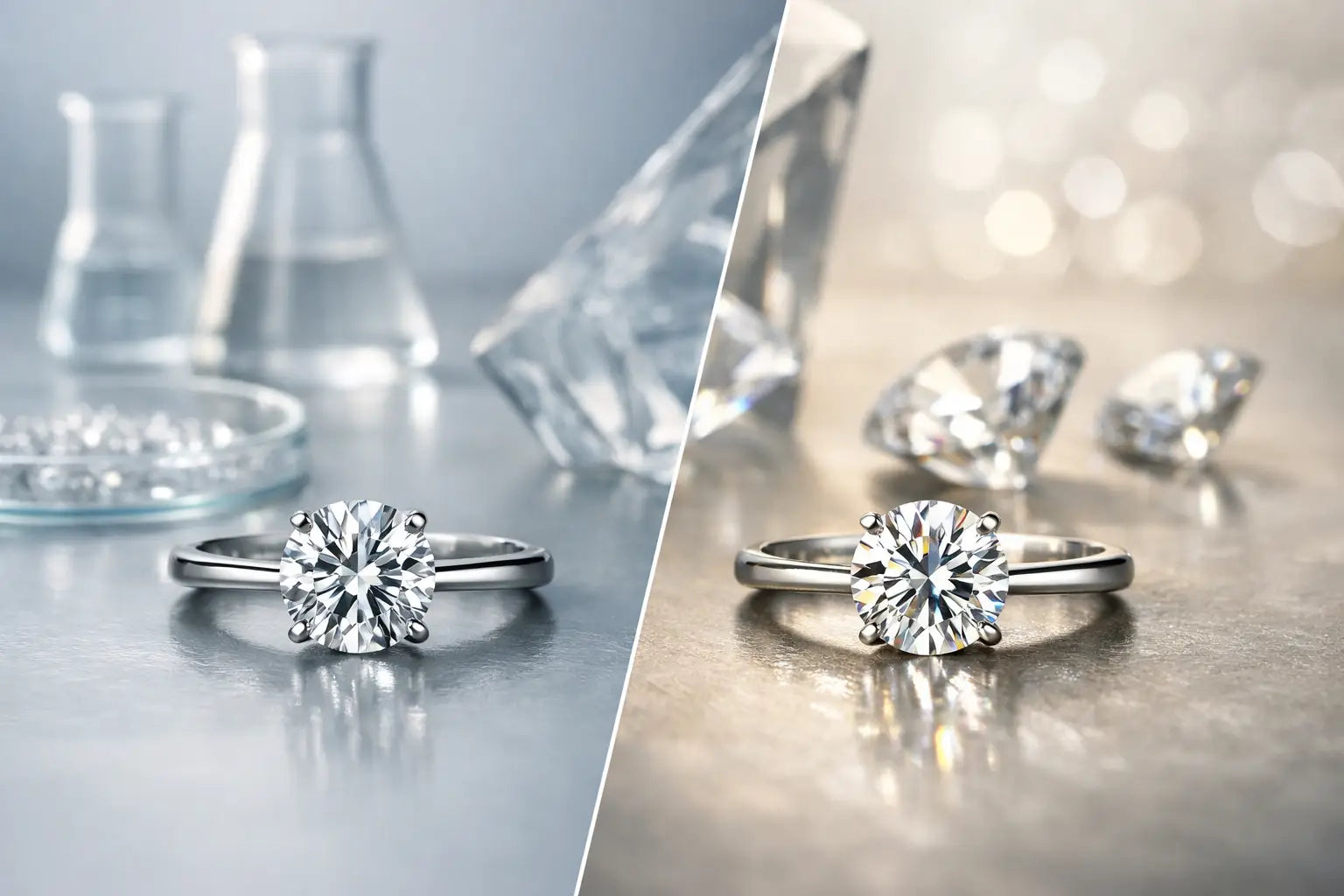
Both stones are highly reflective, but their light performance is not identical. Diamonds are known for a balanced combination of white light, colored flashes, and crisp scintillation. A well-cut lab diamond has the familiar diamond sparkle many people picture when they imagine an engagement ring.
Moissanite has higher dispersion than diamond, meaning it can throw more vivid rainbow flashes, often called fire. Some people love that lively, almost electric effect. Others find it more noticeable than they want, particularly in larger center stones or under direct lighting. Moissanite can also show a subtle doubled facet appearance from certain angles because of its crystal structure, while diamond facets generally look sharper and more singular.
Neither visual is objectively better. The key is preference. A person drawn to understated, classic brilliance may lean toward a lab diamond. Someone who wants a stone that announces itself with colorful sparkle may genuinely prefer moissanite. Whenever possible, view each stone in several lighting conditions instead of making a decision based on one studio image.
Cut still determines beauty
Material alone does not guarantee a beautiful stone. Cut has an enormous influence on brightness and patterning. A poorly proportioned diamond can appear dark or dull, while a thoughtfully cut moissanite can look striking and full of life.
For lab diamonds, review the stone's proportions, symmetry, polish, and grading information along with videos or images. For moissanite, pay attention to how its facet pattern looks at the size and shape you want. Elongated cuts, rounds, and step cuts can each emphasize sparkle differently.
Durability for Everyday Rings
An engagement ring faces more than special occasions. It meets desk edges, gym bags, kitchen counters, hand sanitizer, and the occasional hurried reach into a drawer. Durability deserves real weight in your decision.
Diamond ranks 10 on the Mohs scale of hardness, making it the hardest commonly used jewelry gemstone. Moissanite ranks around 9.25, which is also exceptionally durable and well suited to daily wear. Both resist scratching far better than many popular gemstones.
A lab diamond has the advantage if you want the greatest possible hardness and the traditional choice for an heirloom-style engagement ring. Yet moissanite is not fragile or impractical. With a protective setting, sensible care, and periodic inspection of prongs, either stone can serve beautifully for years.
Stone security is often more important than the small difference in hardness. A low-profile setting, sturdy prongs, and a design appropriate for your lifestyle can protect either choice. For highly active hands, consider a bezel, cathedral setting, or other design that gives the center stone extra support.
Price, Size, and What You Value Most
Price is where the choice can become especially personal. Moissanite typically costs less than a lab-grown diamond of a comparable face-up size. That can make it possible to choose a larger center stone while staying within a firm budget, or to direct more of the budget toward an elaborate setting, wedding band, or another life goal.
Lab-grown diamonds are also considerably more accessible than comparable mined diamonds, while retaining the material identity and appearance of diamond. For many couples, this creates an appealing middle ground: a substantial, certified diamond with room in the budget for a more refined cut, a higher color grade, or a meaningful custom setting.
Do not compare price using carat weight alone. Moissanite weighs differently than diamond, so sellers often describe moissanite by its diamond-equivalent size. Compare millimeter measurements to understand how large a stone will look from the top. A 2-carat-equivalent moissanite and a 2-carat diamond may have a similar diameter, but they are not equivalent materials.
It also helps to be honest about what the ring needs to communicate to you. If having a genuine diamond is central to the moment, a lab-grown diamond may feel worth the additional investment. If the look, size, and day-to-day enjoyment matter more than diamond identity, moissanite can offer remarkable visual impact.
Certification, Transparency, and Confidence
A lab-grown diamond can come with an independent grading report that identifies it as laboratory-grown and documents key quality characteristics. This gives buyers a common language for comparing stones and provides useful records for ownership, insurance, and future service.
Moissanite may come with a certificate of authenticity or quality documentation, but it is not generally graded through the same diamond-report system. That does not make it less legitimate. It simply means the buying process is different. Ask for clear information about the stone's dimensions, color appearance, cut, warranty, and the materials used in the setting.
For either choice, transparency should extend beyond the center stone. Confirm the metal type, ring size, setting details, return terms, warranty coverage, and maintenance options before placing an order. Fine jewelry should feel exciting, not unclear.
Ethics and Long-Term Expectations
Both lab-grown diamonds and lab-created moissanite avoid the extraction process associated with newly mined gemstones. That is meaningful for shoppers who want a modern alternative to mined-diamond jewelry. Still, thoughtful sourcing is broader than one label. Manufacturing requires energy, and a responsible purchase also involves transparent practices, quality craftsmanship, and a piece you will value enough to wear for a long time.
It is also wise to separate sentimental value from resale expectations. Jewelry resale markets can vary greatly, and neither lab-grown diamonds nor moissanite should be purchased primarily as a financial investment. Their strongest value is personal: the proposal, the promise, the achievement, or the everyday confidence that comes from wearing something made for you.
A lab-grown diamond may be the more natural fit if you expect to use diamond-specific services such as future upgrades or want a stone documented through diamond grading. Moissanite can be the right fit if you prefer to allocate more of your budget to design, size, or other priorities. The best path depends on the services available to you and the ownership experience you want.
Choosing the Stone for Your Ring Design
Your setting can make the answer clearer. In a delicate solitaire, a lab diamond delivers a timeless, crisp focal point. In a halo, three-stone ring, or fashion-forward design, either option can be beautiful, although moissanite's stronger fire may become more pronounced when several stones catch the light together.
Metal color matters, too. Yellow or rose gold can make a near-colorless stone look intentionally warm and romantic. Platinum or white gold emphasizes a cool, icy appearance. If you are choosing a large oval, emerald cut, radiant, or pear shape, ask to see how the specific cut performs rather than assuming every stone of that shape will look alike.
For a custom design, begin with the feeling you want the ring to have: quiet and classic, bold and glamorous, vintage-inspired, or distinctly modern. Then choose the gemstone that supports that vision. A skilled consultation can help translate a budget and a few saved images into practical decisions about stone proportions, setting security, metal, and wearability.
The right ring does not need to win an argument about sparkle. Choose the stone that makes you pause when you see it, then build a setting worthy of the moment you are celebrating.