How Are Lab-Grown Diamonds Made? The 2026 Science of Cultivation
Did you know that 61% of engagement rings purchased last year featured a lab-grown center stone? This shift reflects a growing realization that you don't need to mine the earth to find a perfect diamond. It's natural to feel skeptical or overwhelmed by technical jargon when you first ask, how are lab grown diamonds made. You might wonder if these stones are just high-quality glass or if they'll truly stand the test of time like a traditional gem.
We agree that choosing a custom bracelet or ring is an emotional investment that requires transparency. In this guide, we'll demystify the 2026 science of diamond cultivation, showing you how carbon seeds transform into chemically identical, brilliant stones. You'll learn the difference between CVD and HPHT methods and see why modern standards classify these as authentic, premium choices for your next heirloom.
Key Takeaways
- Learn why lab-grown diamonds are 100% pure carbon and share the exact chemical lattice as mined stones, ensuring they're real gems rather than "simulants."
- Compare the master methods of HPHT and CVD to understand the specific scientific environments and how are lab grown diamonds made today.
- Follow the transition from raw rough crystals to brilliant, polished stones that are ready for your custom made-to-order rings or bracelets.
- Navigate the 2026 certification landscape with confidence, knowing how GIA and IGI reports verify the origin and premium quality of your lab diamond.
Cultivating Brilliance: What Are Lab-Grown Diamonds Made Of?
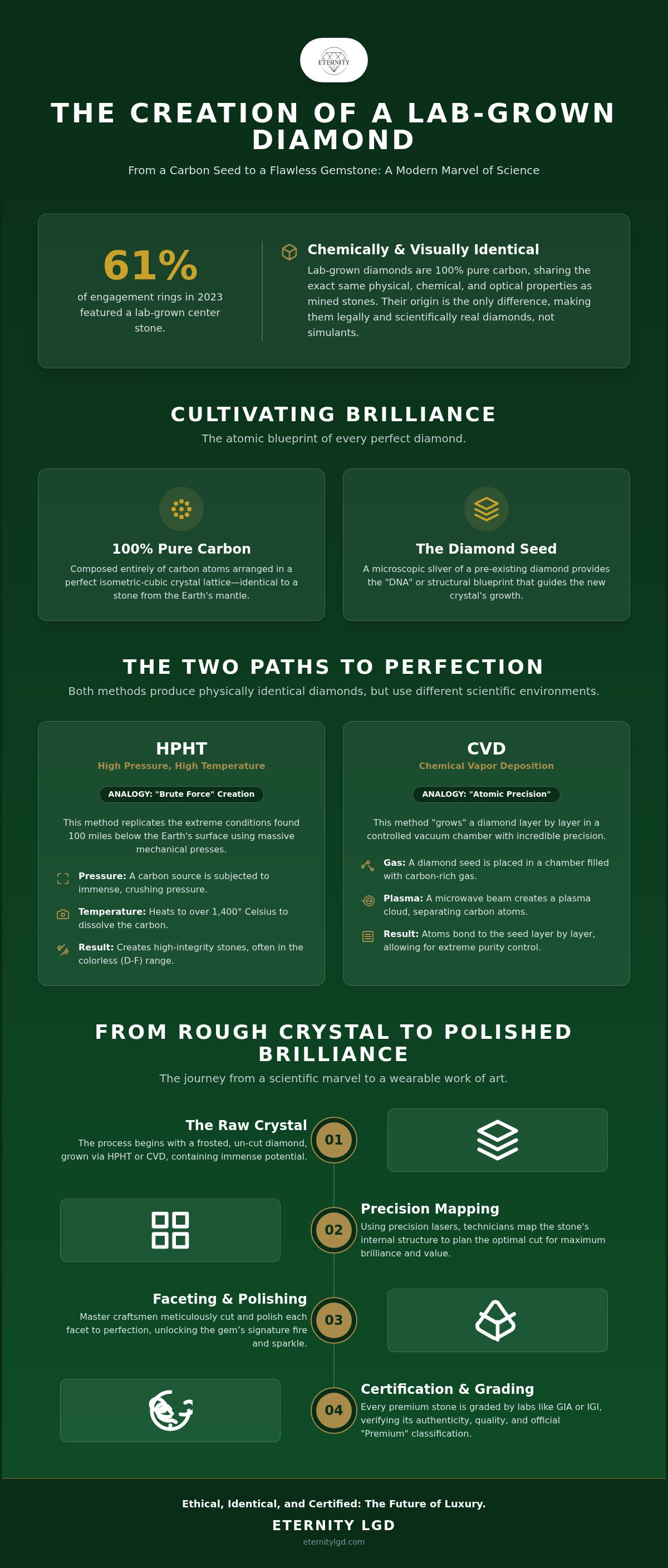
To understand how are lab grown diamonds made, we first need to look at their atomic composition. These gemstones are composed of 100% pure carbon, arranged in the exact same isometric-cubic crystal lattice as stones found deep within the Earth's mantle. Because they share identical physical, chemical, and optical properties, they aren't "simulants" like cubic zirconia. Instead, they're the result of advanced scientific replication of the high-energy conditions that occur naturally in geology.
The Federal Trade Commission (FTC) legally classifies these as real diamonds because their origin is the only thing that distinguishes them from a mined stone. Modern technology allows us to cultivate these gems in a controlled environment, ensuring every piece meets high standards for ethical sourcing. You can explore the are lab grown diamonds real diamonds expert verdict to see why the industry has embraced this transparent alternative to legacy luxury.
The Diamond Seed: The Blueprint of Every Stone
Every journey toward a finished gemstone begins with a diamond seed. A diamond seed is the microscopic foundation upon which carbon atoms arrange themselves into a crystal lattice. This thin sliver of pre-existing diamond acts as the "DNA" or blueprint for the growth process, providing the structural instructions that carbon atoms follow as they bond together layer by layer.
Selecting a high-quality seed is critical because its internal characteristics directly influence the final gemstone's clarity and structural integrity. Just as a master craftsman relies on a perfect blueprint for a custom fashion ring, scientists use these seeds to ensure the resulting crystal is flawless. This precision is a key part of how are lab grown diamonds made to reach the "Premium" standards now recognized by major grading laboratories in 2026.
The Two Master Methods: How Lab Diamonds Are Grown
The environment where a diamond grows determines its final character. Understanding how are lab grown diamonds made involves exploring two distinct scientific paths: High Pressure High Temperature (HPHT) and Chemical Vapor Deposition (CVD). Both methods produce gems that are identical to mined ones, but they utilize different physics to achieve that goal. While the techniques vary, the result is a stone that is indistinguishable to the naked eye from a mined counterpart. You can read more about these differences in our guide on lab diamonds vs diamond simulants.
In 2026, many leading labs have transitioned to AI-driven process controls and renewable energy sources. This technology has improved production efficiency by 25%, ensuring that your gemstone is as sustainable as it is beautiful. Choosing between these methods often depends on the specific requirements of your jewelry design.
HPHT vs. CVD: Choosing the Right Growth Path
The HPHT method is often described as "brute force." It uses massive mechanical presses to subject a carbon source to temperatures exceeding 1,400 degrees Celsius and crushing pressures. This mimics the extreme conditions found 100 miles below the Earth's surface. It's a powerful way to create large stones with high structural integrity.
Conversely, CVD offers "atomic precision." Scientists place a diamond seed in a vacuum chamber filled with carbon-rich gas. A microwave beam creates a plasma cloud, causing carbon atoms to rain down and bond to the seed layer by layer. This method allows for incredible control over the diamond's purity. If you are looking for specific loose diamonds for a bespoke project, these nuances help you select the perfect stone. How are lab grown diamonds made to look so perfect? It's all about this controlled, step by step cultivation.
| Feature | HPHT Method | CVD Method |
|---|---|---|
| Growth Speed | Rapid | Moderate/Controlled |
| Typical Color | D to F (often colorless) | D to H (very high clarity) |
| Common Sizes | Small to very large | Large, high-quality plates |
From Raw Crystal to Custom Made-to-Order Luxury
The journey doesn't end when the growth chamber opens. After understanding how are lab grown diamonds made, it's fascinating to see the "Rough to Radiant" transition. These raw crystals emerge as frosted blocks that require the touch of master craftsmen. Using precision lasers, technicians map the internal structure of the rough stone to plan the most brilliant cut possible. Each facet is then polished to perfection, transforming a scientific marvel into a stunning center stone for an engagement ring or fashion bracelet.
In 2026, verification is more important than ever. Every premium stone should carry an IGI or GIA certificate to confirm its origin and quality. While the GIA now uses a simplified "Premium" or "Standard" classification for lab stones, these reports ensure you're getting exactly what you pay for. For those seeking the ultimate level of personalization, selecting loose diamonds for custom jewelry allows you to be the architect of your own heirloom.
The Ethics of Engineering: Why the Process Matters
Choosing lab-grown isn't just about the science; it's about the soul of the piece. The controlled environment of a lab allows for the creation of Type IIa diamonds. These represent the purest form of diamond found in nature, making up only 1 to 2% of mined stones. Because the supply chain is entirely transparent, you can feel confident that your jewelry aligns with modern ethical standards.
This transparency makes custom lab-grown diamond jewelry a powerful status symbol of conscious luxury. It bridges the gap between high-end design and moral value. By understanding how are lab grown diamonds made, you're empowered to choose a stone that is physically perfect and ethically sound for your next bespoke project.
Designing Your Future with Conscious Brilliance
Understanding how are lab grown diamonds made reveals a world where scientific innovation meets timeless beauty. You now know that these stones are chemically identical to mined gems; they are grown through precise methods like CVD and HPHT to reach the highest standards of purity. By choosing a cultivated diamond, you're embracing a transparent supply chain that values ethics as much as aesthetics.
At Eternity LGD, we specialize in made-to-order sustainable luxury. Our GIA and IGI certified loose diamonds serve as the perfect blueprint for your unique design. This direct-to-consumer model ensures you receive expert guidance and transparency at every stage. Whether you're envisioning a custom bracelet or a one-of-a-kind engagement ring, you have the power to create something truly extraordinary. Start your custom jewelry journey with Eternity LGD and turn your vision into a radiant reality.
Frequently Asked Questions
How long does it take to make a lab-grown diamond?
It typically takes between two weeks and a month to grow a gem-quality diamond in a laboratory setting. This speed is a key advantage of how are lab grown diamonds made today, as CVD and HPHT methods accelerate the process by creating concentrated carbon environments. The exact timing depends on the desired carat size, as larger crystals require a slower, more stable growth rate.
Are lab-grown diamonds as durable as mined diamonds?
Lab-grown diamonds are exactly as durable as mined diamonds because they share the same atomic structure. Both stones rank as a 10 on the Mohs scale of hardness, which is the highest rating possible for any mineral. Whether you choose a custom ring or a made-to-order bracelet, your stone will withstand daily wear and maintain its brilliance for generations.
Can you tell the difference between a lab-made and a natural diamond?
You cannot tell the difference between a lab-made and a natural diamond with the naked eye or a standard jeweler's loupe. Since they are chemically identical, only specialized laboratory equipment can detect the microscopic growth patterns that distinguish them. This is a testament to how are lab grown diamonds made, ensuring your custom jewelry possesses the same fire as any legacy gem.
Do lab-grown diamonds have flaws or inclusions?
Lab-grown diamonds can have flaws or inclusions, as the growth process is a scientific replication of a natural event. Tiny internal characteristics often form while the carbon atoms are bonding in the chamber. These stones are still graded on clarity scales by the IGI or GIA, allowing you to select a specific loose diamond that meets your personal standards for perfection.
Disclaimer
The information provided in this article is for educational and informational purposes only and should not be considered professional financial, legal, investment, or gemological advice. While Eternity strives to ensure all information is accurate and up to date, diamond grading standards, market prices, industry practices, and product availability may change over time.
All opinions expressed are based on current industry knowledge and are intended to help consumers make informed decisions. Product specifications, pricing, promotions, and services may vary and are subject to change without notice.
Lab-grown diamonds sold by Eternity are independently graded by recognized laboratories such as IGI or GIA where applicable. We encourage customers to consult with our jewelry specialists for recommendations tailored to their individual needs before making a purchase.
© Eternity Inc. All rights reserved. This content may not be reproduced without written permission.