Lab Made Diamond Rings vs. Mined: 2026 Myth-Busting Guide
The hardest substance on Earth no longer requires a shovel to find it. While the industry once equated rarity with a hole in the ground, 2026 has proven that scientific mastery replicates nature's work perfectly. You might feel some hesitation when choosing lab made diamond rings, wondering if they truly match the "real" thing or if they're simply high-end imitations.
It's natural to want absolute certainty before making such a significant investment. You deserve to know that your choice is backed by science and recognized by global authorities as an authentic diamond. This guide will debunk the most persistent myths about quality and origin, providing the technical facts you need to move forward with confidence.
We'll look at current 2026 certification standards, compare physical properties, and show you how modern engineering creates a masterpiece of both ethics and beauty.
Key Takeaways
- Understand why lab-grown diamonds are chemically identical to mined stones and why the FTC officially recognizes them as real diamonds rather than imitations.
- Learn how the streamlined supply chain for lab made diamond rings allows you to invest in a larger, higher-quality stone without the traditional mining markup.
- Discover the criteria for truly sustainable jewelry by contrasting the transparent origin of lab stones with the complex environmental history of mined alternatives.
- Gain the confidence to verify your purchase using 2026 GIA and IGI certification standards to ensure long-term durability and authenticity.
The "Real vs. Fake" Debate: Are Lab Made Diamond Rings Actually Real?
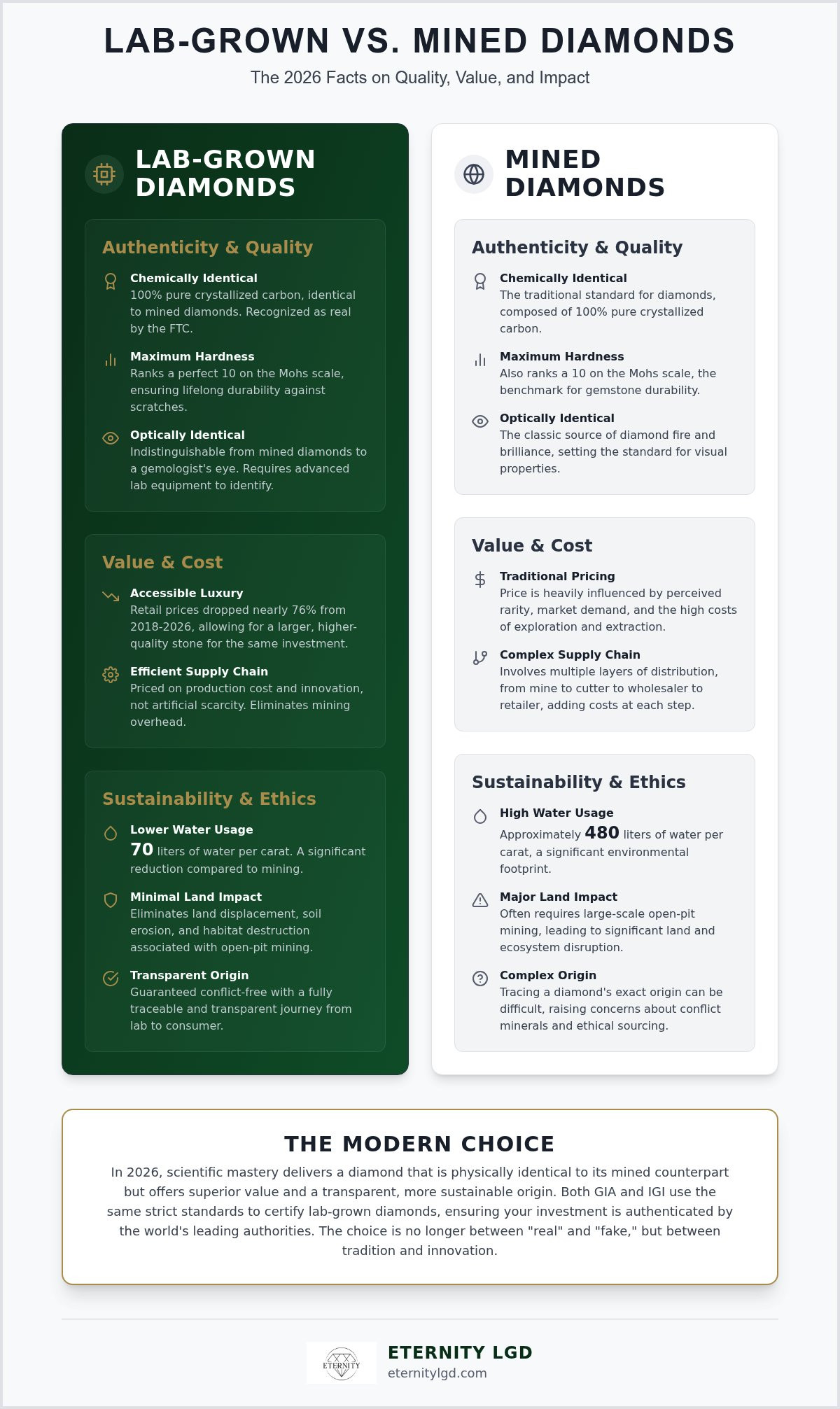
One of the most persistent hurdles for buyers is the fear that lab made diamond rings are somehow "lesser" or "artificial." This confusion often stems from previous experiences with diamond simulants. It's vital to recognize that materials like cubic zirconia or moissanite are entirely different chemical compounds that merely mimic the sparkle of a diamond. In contrast, a lab-grown stone is 100% pure carbon, making it a true diamond in every sense of the word.
You can think of these stones as technological twins rather than imitations. Just as a greenhouse-grown orchid is botanically identical to one found in the wild, a diamond grown in a controlled environment is indistinguishable from one formed deep within the Earth. A Synthetic diamond shares the exact atomic structure as its mined counterpart, offering the same fire and brilliance. Lab diamonds are chemically, physically, and optically identical to those from the earth.
Chemical, Physical, and Optical Identity
When we look at durability, both lab-grown and mined stones rank as a 10 on the Mohs scale of hardness. This is the highest possible rating, ensuring that your ring won't scratch, cloud, or degrade over decades of wear. Because the crystalline structure is the same, lab made diamond rings react to light in the exact same way, producing the signature "scintillation" that defines a high-quality gem.
Even seasoned gemologists cannot tell the difference using a standard jeweler’s loupe. Detection requires specialized laboratory equipment designed to identify minute growth patterns. This level of scientific perfection is why these stones are now the centerpiece of Lab Grown Diamond Engagement Rings: The 2026 Guide to Modern Luxury, blending modern innovation with timeless elegance.
Decoding Value: Why Lab Created Rings Offer More Without Compromising Quality
A common misconception suggests that the lower price of lab made diamond rings implies a compromise in quality. This couldn't be further from the truth. The retail price of a one-carat lab-grown diamond dropped by nearly 76% between 2018 and 2026, yet the physical perfection of these stones has only improved. This price adjustment isn't about "cheapness"; it's a reflection of a vastly more efficient supply chain that removes the heavy overhead of traditional mining.
By eliminating the costs associated with land displacement and complex international distribution layers, creators can focus entirely on the gem's quality. This efficiency allows you to prioritize the "4Cs" (Cut, Clarity, Color, and Carat) without the "origin tax" found in mined stones. You can often secure a stone with superior color and clarity for a fraction of the cost of a lower-grade natural diamond. Scientific rigor remains high, as evidenced by GIA Laboratory-Grown Diamond Services, which uses the same strict grading standards for lab stones as they do for mined ones.
For those seeking the ultimate control over their investment, using loose diamonds for custom jewelry is a strategic way to maximize value. It allows you to hand-select a stone that meets your exact aesthetic standards while ensuring every dollar goes toward the beauty of the gem itself.
The Price Gap Explained: Efficiency vs. Scarcity
Traditional diamond pricing is often built on artificial scarcity and high-impact extraction. Lab-grown diamonds, however, are priced based on the actual cost of production and innovation. This shift makes high-end lab made diamond rings accessible to a wider range of conscious consumers. In 2026, savvy buyers are moving away from traditional status symbols and prioritizing the visible quality of the stone. They recognize that a diamond's beauty comes from its crystalline structure, not the method of its arrival. If you're ready to explore these modern standards, you can browse our ready stock collection to see this value in person.
Ethical and Environmental Myths: Is "Lab-Made" Truly Sustainable?
While the environmental benefits of lab made diamond rings are significant, it's a myth that every lab-grown stone is perfectly "green." Actual sustainability depends heavily on the energy source used by the laboratory. However, the comparative data remains compelling for conscious shoppers. Traditional mining uses approximately 480 liters of water per carat; lab creation requires only about 70 liters. The process also avoids the massive land displacement and soil erosion caused by open-pit mining. Choosing a stone created with renewable energy ensures your purchase aligns with modern 2026 luxury standards.
Traceability is where lab-grown stones truly outshine their mined counterparts. Every stone has a documented history from the moment the carbon "seed" is placed in the chamber to the final polish. This transparency eliminates the ethical gray areas often associated with the Kimberley Process. If you want a piece that reflects your values, exploring custom lab grown diamond engagement rings offers a fully transparent journey from concept to creation.
Traceability and Conflict-Free Assurance
Lab-grown diamonds are inherently conflict-free because their origin is controlled and observable. There's no risk of funding regional violence or labor exploitation that has historically plagued the mining industry. Leading authorities like the IGI and GIA provide detailed certifications that act as a "birth certificate" for each stone, documenting its specific growth method and quality. At Eternity, we prioritize this level of ethical transparency, ensuring that your lab made diamond rings are as morally sound as they are beautiful. Our 2026 commitment means pulling back the curtain on every step of the sourcing process, providing you with absolute peace of mind.
Choosing Your Future Heirloom with Confidence
The landscape of modern luxury has shifted toward transparency and scientific mastery. By choosing lab made diamond rings, you're embracing a standard of excellence that prioritizes physical truth over outdated industry myths. You now have the facts to confirm that these stones are chemically identical to mined diamonds, offering the same 10 Mohs hardness and lifelong brilliance. Beyond the physics, the streamlined supply chain allows you to secure a higher-grade stone that is 100% traceable and conflict-free.
Every piece we offer features GIA or IGI certified stones, ensuring your investment meets the highest global standards. Whether you're interested in ready-stock styles or master-crafted custom designs, you can move forward with total peace of mind. Ready to see the brilliance for yourself? Browse our collection of lab-grown diamond rings. Your journey toward a conscious, beautiful future starts with a single, brilliant choice.
Frequently Asked Questions
Can you tell the difference between lab-grown and mined diamonds with the naked eye?
No, it's impossible to distinguish between the two with the naked eye. Because they are chemically and optically identical, they interact with light in the exact same way. Even expert gemologists require advanced laboratory tools to identify the specific growth patterns that separate them. Your lab made diamond rings will display the same fire and brilliance as any mined stone.
Do lab-made diamond rings have any resale value in 2026?
Yes, lab-grown diamonds have resale value, but it's typically lower than the initial purchase price. In 2026, the secondary market for these stones is still maturing. It's best to buy lab diamonds for their aesthetic beauty and ethical benefits rather than as a financial asset. The real value lies in the significant upfront savings you enjoy at the time of purchase.
Will a lab-grown diamond ring get cloudy or change color over time?
No, a lab-grown diamond will never become cloudy or yellow over time. Unlike simulants that may degrade or scratch, lab made diamond rings are made of pure carbon crystals that don't react to heat or chemicals. This ensures that the clarity and color you see on day one will remain unchanged for generations, regardless of how often you wear your jewelry.
Is a lab-grown diamond as hard as a mined diamond?
Yes, these stones are exactly as hard as mined diamonds. Both reach a 10 on the Mohs scale, which is the highest possible rating for mineral hardness. This means they are incredibly durable and resistant to scratches. You can wear a lab-grown stone every day with the same confidence in its strength as any natural diamond.
Disclaimer
The information provided in this article is for educational and informational purposes only and should not be considered professional financial, legal, investment, or gemological advice. While Eternity strives to ensure all information is accurate and up to date, diamond grading standards, market prices, industry practices, and product availability may change over time.
All opinions expressed are based on current industry knowledge and are intended to help consumers make informed decisions. Product specifications, pricing, promotions, and services may vary and are subject to change without notice.
Lab-grown diamonds sold by Eternity are independently graded by recognized laboratories such as IGI or GIA where applicable. We encourage customers to consult with our jewelry specialists for recommendations tailored to their individual needs before making a purchase.
© Eternity Inc. All rights reserved. This content may not be reproduced without written permission.