Article: Solitaire Versus Halo Engagement Rings Compared
Solitaire Versus Halo Engagement Rings Compared
The difference between solitaire versus halo engagement rings becomes clear the moment you picture them on a hand. One lets a center diamond take the entire spotlight. The other creates a brighter, more detailed frame around it. Neither is automatically better. The right choice depends on how you dress, what you want your ring to say, and where you want to put your diamond budget.
For many couples, this decision is less about following a trend and more about choosing a design that will still feel personal years from now. A lab-grown diamond gives you flexibility to prioritize the qualities that matter most, whether that means a larger center stone, higher color and clarity, or a setting with more intricate brilliance.
Solitaire Versus Halo Engagement Rings: The Core Difference
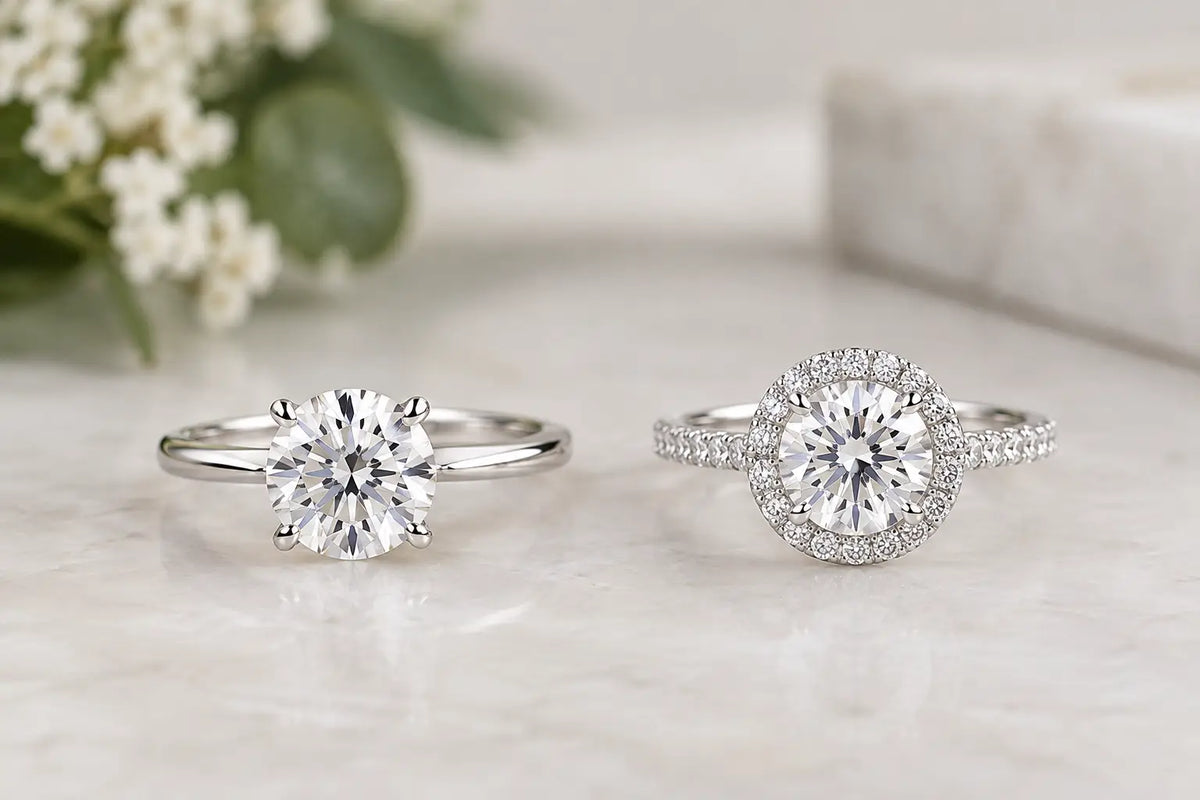
A solitaire engagement ring features one center diamond as the visual focus. Its clean setting may use prongs, a bezel, or a low-profile basket, but the design remains intentionally restrained. The diamond's shape, cut, and proportions do the talking.
A halo engagement ring surrounds the center diamond with a border of smaller diamonds. That border can be round, square, floral, hidden beneath the center stone, or shaped to follow an oval, pear, cushion, or radiant diamond. The halo adds surface sparkle and can make the center stone appear larger from the top view.
Think of a solitaire as a beautifully tailored white shirt: simple, versatile, and dependent on excellent materials. A halo is more like a tailored look with jewelry already built in: luminous, expressive, and full of detail. Both can be classic, modern, romantic, or bold depending on the diamond shape and metal choice.
Why a Solitaire Ring Has Lasting Appeal
Solitaire rings are beloved for their clarity of design. With no surrounding stones competing for attention, you see the center diamond more fully from every angle. This makes a solitaire particularly compelling when you have chosen an exceptional cut or a distinctive shape, such as an elongated oval, emerald cut, marquise, or radiant cut.
The style also gives you room to customize without losing its clean character. A yellow gold band can make a colorless diamond feel warm and timeless, while platinum or white gold creates a crisp, contemporary look. A slightly tapered band, cathedral shoulders, or an east-west setting can add personality without turning the ring into something overly ornate.
Practicality is another advantage. A solitaire generally has fewer small stones to inspect over time and is often easier to clean at home. It can also pair naturally with a wide range of wedding bands, from a plain metal band to a diamond eternity style. That flexibility matters if you want to build a stack over the years.
Still, simple does not mean low impact. A solitaire's visual presence relies heavily on center-diamond size, cut quality, and setting proportions. If your budget is fixed, you may need to decide whether you prefer a larger lab-grown diamond with more visible inclusions or a slightly smaller diamond with stronger cut, color, and clarity characteristics. In most cases, a beautiful cut should remain a high priority because it drives the diamond's brightness and fire.
What Makes a Halo Ring So Eye-Catching
A halo ring delivers more sparkle across the finger. The small diamonds around the center catch light from multiple directions, creating a bright, dimensional look that can feel luxurious even with a modest center stone. For shoppers who want maximum visual scale, this effect is one of the halo's strongest advantages.
Halos are especially effective around certain diamond shapes. An oval halo can emphasize length and create a larger-looking silhouette. A cushion-shaped halo can make the design feel soft and romantic. A square halo around a princess or cushion cut can produce a more architectural look. A double halo brings even more drama, though it is usually best suited to someone who genuinely enjoys statement jewelry.
The design can also be a strategic way to allocate a budget. Rather than placing every dollar into a larger center diamond, you can choose a well-cut center stone at a size that feels comfortable and use a halo to enhance its face-up presence. With lab-grown diamonds, couples often have the added opportunity to choose a higher-quality center diamond while still investing in a detailed setting.
There are trade-offs. A halo has more tiny diamonds, which means more settings that should be checked periodically. The design may also require a contoured or custom wedding band if the halo sits low or extends beyond the center setting. None of that should rule it out, but it is worth considering before you fall in love with the view from above.
Size, Sparkle, and Center-Diamond Focus
If you want the center diamond to look as large as possible, both styles can work, but they achieve the effect differently. A solitaire puts all visual attention on the center stone itself. Choosing an elongated shape, a slim band, or a setting that exposes more of the diamond can help it appear larger.
A halo creates an optical expansion around the center diamond. From a normal viewing distance, the combined diamond surface can read as one larger, brighter presentation. This is particularly helpful if you prefer the look of a substantial ring but do not necessarily need every millimeter of that look to come from one center stone.
For pure sparkle, a halo usually wins because it contains more diamond facets overall. For a stronger sense of a single, important diamond, a solitaire wins. The question is whether you are drawn to a focused flash of light or a broader field of brilliance.
Consider Your Everyday Routine
An engagement ring should fit real life, not only proposal photos. If you work with your hands, wear gloves frequently, exercise often, or prefer low-maintenance jewelry, discuss setting height and security before choosing either style. A low-set solitaire or bezel solitaire may be especially practical, while a halo can be designed with a protective, lower profile as well.
Cleaning habits matter too. Lotions, soap, and everyday residue can dull any diamond ring. A solitaire is usually quicker to clean because there are fewer spaces around the center stone. A halo benefits from more careful cleaning between the small diamonds so its sparkle remains even and bright.
Style longevity is personal. Some people appreciate the solitaire because it adapts easily as their taste changes. Others love a halo precisely because it feels more decorative and romantic from day one. Do not choose a solitaire simply because it is traditional, or a halo simply because it looks larger online. Try to imagine the ring with your daily wardrobe, future wedding band, and favorite pieces of jewelry.
Metal and Diamond Choices Change the Look
The same setting style can look completely different depending on metal and diamond shape. A round brilliant solitaire in platinum is crisp and enduring. Set that same diamond in yellow gold with a slender band, and it becomes warmer and more vintage-inspired. An oval halo in rose gold can feel soft and romantic, while an emerald-cut diamond with a geometric halo leans refined and glamorous.
For halo rings, matching the color of the center diamond and surrounding stones is especially helpful. A noticeably warmer center diamond next to very bright halo diamonds can make the contrast more visible. This is not always undesirable, but it should be a deliberate design choice rather than a surprise.
A personalized consultation can help you compare these details side by side. At Eternity LGD, the custom process can start with the diamond and then refine the setting around your preferred proportions, metal, lifestyle, and budget. That approach is useful when you love features from both styles, such as a solitaire profile with a hidden halo beneath the center diamond.
Which Ring Is Right for You?
Choose a solitaire if you value clean lines, easy pairing with wedding bands, and a center diamond that remains the undisputed focal point. It is an excellent fit for minimalists, lovers of classic jewelry, and anyone who wants design flexibility over time.
Choose a halo if you enjoy visible sparkle, intricate detail, and a larger overall look on the finger. It is a natural fit for someone who wants romantic dimension or a more expressive ring without relying entirely on a very large center diamond.
The most meaningful choice is the one you will enjoy reaching for every morning. Ask to see your preferred diamond shape in both settings, look at them in natural light, and pay attention to the design that feels immediately like yours.